
|
 22nd July 2008, 04:13 AM
|
#1 |
|
Member
Join Date: Dec 2004
Location: NC, U.S.A.
Posts: 2,236
|
 Barbary corsairs/swords
OK, I know we're been down this path before with pirate weapons (one of my favorite subjects!), so here goes with another question. The recent Zanzibar sword got my interest up. In regards to the Barbary Corsairs and Algerian pirates of the 18th-early 19th century, of the swords from those lands (Rif Valley, Morocco, etc), which had the most likeliness of being carried to sea- the Berber saber, the nimcha/Zanzibar sword, the saif, the flyssa, or ? Most of the Berber sabers I've seen seem to be more mid-19th century and of course, there are those 'wedding nimcha' that keep turning up!
 I know that sea-faring warriors carried whatever they laid hands on, but realistically, I wonder what museums or records show they typically carried? Many of the pics I've seen have them carrying "fantasy-type" clipped point shamshirs or talwar. NOT likely! What of the Moroccan daggers (kourami, I think hey are called?). Opinions, please? Last edited by M ELEY; 22nd July 2008 at 04:15 AM. Reason: Forgot text |

|

|
|
22nd July 2008, 04:39 AM
|
#2 |
|
Member
Join Date: Jun 2008
Posts: 119
|
i think the mooroccan daggers are called "koumiya"
|
|
|
|
|
22nd July 2008, 07:35 AM
|
#3 |
|
Arms Historian

Join Date: Dec 2004
Location: Route 66
Posts: 10,867
|
Hi Mark,
I'm right with ya! Definitely an interesting faction of piracy, and the thought of what weapons might have been used brings lots of ideas. It seems like this was big business based in ports of the Maghreb (known as the Barbary Coast for the prevalent Berber inhabitants )from medieval times through the 19th century. Since these scalawags were primarily procuring slaves for this industry in Ottoman controlled regions, it would seem that the weapons of that Empire were likely most common. While combat at sea was surely not unusual, much of thier action consisted of raids on land, so swords of regular size, especially like the Moroccan 'nimcha' or sa'if probably became regularly seen. Since these type hilts were known in the familiar form by the 17th century (as seen in English paintings being worn by two English nobles in the instances I've seen) it would seem these were certainly one form used. The appearance in English paintings may be from either British interaction with these pirates, or from diplomatic-trade interaction. I have seen some references on the Barbary Pirates which had line illustrations using the Ottoman kilij with the pistol grip hilt, and it does not seem far fetched to consider yataghans in thier sashes. While these thoughts reflect logical candidates for the weapons most likely used, it would be great to see some of the paintings etc illustrating the perspective and possibly license of the artists posted here. I really doubt the flyssa ever got to sea, unless one of the short dagger type. The full size ones remain a mystery as to how they were actually used, and they were only around for a short time in the 19th century. Another mystery, those 'Berber' sabres with profiled points, they too seem a 19th century phenomenon said to be from Morocco, yet they have eluded any contemporary notice from any study or review of arms from there. They do seem like a great weapon for pirate use though, even if from a simply aesthetic view. I really look forward to seeing Barbary Pirates illustrations, and lets see some nimchas!!! All best regards, Jim |

|
|
|
22nd July 2008, 09:09 AM
|
#4 |
|
Member
Join Date: Dec 2004
Location: NC, U.S.A.
Posts: 2,236
|
Amen,Jim, and thanks for responding. Yes, I do hope someone can produce some illustrations from the era to enlighten us. I had forgotten about the slavery angle (other than the Midaeval slavery of the Corsairs taking Christians as slaves and the Maltese corsairs taking the Muslim pilgrims in kind). Land raids would have likely shown regular-sized swords as you stated. Ottoman swords make sense, and I see your point about the flyssa and Berber sabers. What would an Algerian pirate of the day carry, I wonder?
|
|
|
|
|
22nd July 2008, 03:12 PM
|
#5 |
|
Vikingsword Staff

Join Date: Nov 2004
Posts: 6,441
|
 Google Image Search
|
|
|
|
|
22nd July 2008, 03:54 PM
|
#6 |
|
Arms Historian
Join Date: Dec 2004
Location: Route 66
Posts: 10,867
|
Hi Mark,
I enjoyed revisiting the pirate topic too! Its funny, I've of course been familiar with the term Barbary Pirates for as long as I can remember, but never really thought about them specifically in terms of who they really were or what thier weapons might have been. I really had no idea these pirates had such a vast range of operation, thinking they simply stayed close to the coast of North Africa. It appears they 'went shopping' for slaves not only in the Meditteranean but to England and further north, even to Iceland! In looking at the term Barbary Pirates, as noted this derives from the Berbers and that association is well known, but became very curious about the term 'corsair'. In considering the pirates from the Golden Age, we have learned of the term Buccaneers as well as Privateers, and know that the Privateers were essentially 'licensed' to prey on shipping with royally issued 'letters of marque'. These often dubious documents would allow the bearer to officially plunder the ships of any 'enemy' power. The term 'corsair' apparantly derives from this concept, and in French parlance refers to the commissioning document from the French king. The letter of marque in this case was termed 'lettre de course', which means literally 'racing letter' (race= la course). In French euphemism, the 'race' was the chasing down of enemy ships as prey in this sense. With the well established French presence in the Maghreb, it appears the term became associated colloquially to these Barbary pirates, with reference to Ottoman 'corsairs'. Sometimes it seems like we get sidetracked by terminology, but in many cases when utilizing resources such as contemporary narratives it helps to better understand the variations of terms referring to a particular subject. With that, returning to our Moroccan nimcha/sa'if , these were used along the entire littoral of the Maghreb, although commonly thought of as Moroccan. I would think that these would have been in use parallel to the variety of familiar Ottoman weapons. On other discussions on these Moroccan nimchas, it has long been generally held that these hilts were likely influenced by Italian swords with similar quillon development ("A Late 15th Century Italian Sword", Anthony North, Connoisseur magazine, Dec.1975, p.238-241). I had always presumed that this influence was probably through trade contact, but wonder if the influence might have arisen via incursions into Italy of these raiders as well. Great topic, its great learning more on these guys!! 
|
|
|
|
|
22nd July 2008, 11:06 PM
|
#7 | |
|
(deceased)
Join Date: Dec 2004
Location: Portugal
Posts: 9,694
|
Quote:
|
|
|
|
|
|
22nd July 2008, 11:16 PM
|
#8 |
|
Member
Join Date: Dec 2004
Location: Virginia
Posts: 520
|
I don't have an answer but I may be able to point you towards somewhere that does. The National Maritime Museum in London has a huge collection of documents on pirates and did a 3 year exhibition on it called "Pirates Fact and Fiction" from 1993 to I think 1995
here is thier pirate research page http://www.nmm.ac.uk/server/show/conWebDoc.632 and for africa this may help from the same place http://www.nmm.ac.uk/collections/pri...y=&startrow=85 The Story of the Barbary Corsairs Author: Stanley Lane-Poole Lieut. J. D. Jerrold Kelley 1890 is here http://www.gutenberg.org/files/22169...-h/22169-h.htm and more on pirates from Project Gutenberg http://www.gutenberg.org/wiki/Pirate...c._(Bookshelf) Last edited by RhysMichael; 23rd July 2008 at 12:37 AM. |
|
|
|
|
22nd July 2008, 11:25 PM
|
#9 | ||
|
Member
Join Date: Dec 2004
Location: Virginia
Posts: 520
|
Quote:
From the collection at the Maritime Museum in London Quote:
© National Maritime Museum, Greenwich, London Last edited by RhysMichael; 23rd July 2008 at 12:16 AM. |
||
|
|
|
|
22nd July 2008, 11:31 PM
|
#10 | |
|
Member
Join Date: Jun 2008
Location: The Sharp end
Posts: 2,928
|
Quote:
What a cracker that one is! |
|
|
|
|
|
23rd July 2008, 12:12 AM
|
#11 |
|
Member
Join Date: Dec 2004
Location: Virginia
Posts: 520
|
A painting of Barbarossa Hayreddin Pasha
|
|
|
|
|
23rd July 2008, 12:24 AM
|
#12 |
|
Arms Historian
Join Date: Dec 2004
Location: Route 66
Posts: 10,867
|
Nicely done RhysMichael!!!Excellent references and links, and the provenance on that nimcha is exactly what I was hoping for. The National Maritime Museum does have wonderful resources (sure wish I had a copy of May & Annis here with me, there are some great illustrations in there).
Fernando, I had never heard of crossbows on these corsair vessels, thank you for noting that, we'll look into that more too. Thanks very much guys, Jim |
|
|
|
|
23rd July 2008, 01:12 AM
|
#13 |
|
(deceased)
Join Date: Dec 2004
Location: Portugal
Posts: 9,694
|
Crossbows were a common device among Berberes and Arabs.
These are two examples extracted from ancient portolanos showing the flag of Béjaïa, a city and province in the Algerine Barbary Coast, where piracy was a way of life. |
|
|
|
|
23rd July 2008, 03:41 AM
|
#14 |
|
Member
Join Date: Dec 2004
Location: NC, U.S.A.
Posts: 2,236
|
Excellent information,gents! RhysMichael, great stuff! When I get more time, I'll look more deeply into the listed links. I'd read about Hoppson's exploits somewhere else, but never got to actually see the nimcha itself. It's nice to see one of this early dating matching its later counterparts exactly.Thanks!
Fernando, thanks for the mention of crossbows. Fascinating! On the link that Rick attached, it does show a Corsair with a crossbow. When I first saw it (before reading your comment and seeing the reference to flags), I just figured it was another farsical European depiction of a Berber. Too cool! In thinking about it, it makes perfect sense. Firearms were fairly scarce for many of these poor pirats (except what they could capture from others-note the pic of Barbarossa above with the captured European sword). many of the Maghreb weapons were primitive matchlock devices, so a crossbow would be a welcome alternative. Likewise, it was a silent weapon. When Stephen Decatur snuck into Tripoli in 1804 to destroy the captured U.S. warship, it was under a veil of silence. He allowed his men no firearms in fear of an accidental ignition and all bladed arms had to remain sheathed as not to reflect moonlight and give away their position. In keeping with this theme, the crossbow would have been an ideal pirating weapon to sneak over the side of a ship with. Very cool! 
|
|
|
|
|
23rd July 2008, 07:17 PM
|
#15 |
|
Member
Join Date: Dec 2004
Location: Virginia
Posts: 520
|
The Joassamee Pirates striking off the arm of Capt. Babcock. From THE PIRATES OWN BOOK Authentic Narratives of the Most Celebrated SeaRobbers.
by Charles Ellms Originally published 1837 |
|
|
|
|
23rd July 2008, 07:23 PM
|
#16 |
|
Member
Join Date: Dec 2004
Location: Virginia
Posts: 520
|
From DEWEY AND OTHER NAVAL COMMANDERS.
BY EDWARD S. ELLIS, A.M., Copyright, 1899 CAPTAIN BAINBRIDGE AND THE DEY OF ALGIERS |
|
|
|
|
23rd July 2008, 11:01 PM
|
#17 |
|
Member
Join Date: Dec 2004
Location: Virginia
Posts: 520
|
Last one for a bit lest you all get tired of me posting pictures
Khair ad Din AKA One of the Barbarosa Brothers from a work reference to be from Helen Chapin Metz |
|
|
|
|
24th July 2008, 05:27 AM
|
#18 |
|
Member
Join Date: Dec 2004
Location: Bay Area
Posts: 1,770
|
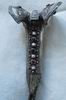
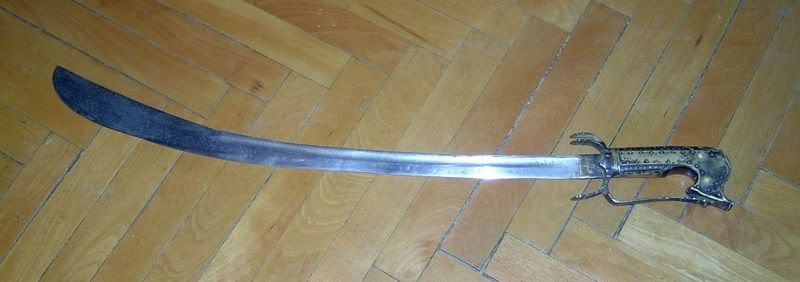
Here are two nimchas, from a Bulgarian private collection (unfortunately not mine), who have always struck me as very suitable for a pirate weapon. One of them is actually similar to the Hopsonn sword. I believe they were collected in Bulgaria - there must have been serious movement of people and weapons in the Ottoman Empire back in the day.
|
|
|
|
|
24th July 2008, 06:17 AM
|
#19 |
|
Member
Join Date: Dec 2004
Location: NC, U.S.A.
Posts: 2,236
|
Wow! Nice nimcha! That top one is particularly amazing with its thickened point! I'd love to get my hands on that one. Rick (RSword) has a truly amazing nimcha that I had the opportunity of holding, with gold leaf inlay. Its amazing how many of these swords are very simple/utilitarian, while others are made of the finest materials. Thanks for sharing.
RhysMichael, that's for posting your pics. The one of the Joassamee pirate with the faux shamshir-type sword got me to thinking. I was complaining about seeing these mock-Persian swords in so many speculative pirate pics and always assumed they were just imaginative. But now, after seeing so many pics with the clipped point swords, I'm truly wondering if this drawing might in fact be alluding to the Berber sabers, with their clipped points? As I mentioned and Jim concurred, most of these seem to be mid-19th century (too late for our time period). Does anyone know of any earlier Berber sabers? Or am I looking too hard at this? I guess the sketches could be a stylized version of a kilij? 
|
|
|
|
|
24th July 2008, 06:33 AM
|
#20 |
|
Member
Join Date: Dec 2004
Location: Bay Area
Posts: 1,770
|
I am not sure if the sketches are reliable - looking at the ship, it does not look like a xebec, the preferred type of vessel for the barbary coast pirates, which had triangular sails. I think the pictures are most the artist's imagination ratherthan an accurate depiction of real pirates and their weapons.
|
|
|
|
|
24th July 2008, 01:56 PM
|
#21 |
|
Member
Join Date: Feb 2006
Posts: 637
|
You have to remember the reason a lot of these nimcha's are so late is because they were still in use. The slave trade was still legal in Morocco untill I beleive 1918 and in Mauritania untill 2002.
|
|
|
|
|
24th July 2008, 03:17 PM
|
#22 | |
|
Member
Join Date: Dec 2004
Location: Virginia
Posts: 520
|
Quote:
|
|
|
|
|
|
26th July 2008, 06:12 PM
|
#23 |
|
(deceased)
Join Date: Dec 2004
Location: Portugal
Posts: 9,694
|
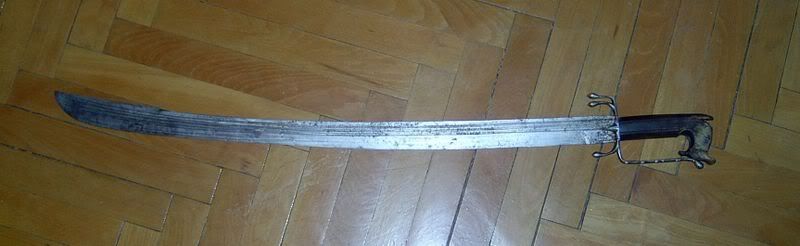
Clandestine pictures taken at the Lisbon Military Museum.
The text in the tag mentions that this nimcha (?) was the sword prefered by Moroccan pirates of the XIX century. These are not the right words, but such was the sense. Fernando |
|
|
|
|
26th July 2008, 06:43 PM
|
#24 |
|
Vikingsword Staff
Join Date: Nov 2004
Posts: 6,441
|

How interesting !
A Parang Nabur .  These swords seem to have gotten around . Last edited by Rick; 26th July 2008 at 07:00 PM. |
|
|
|
|
27th July 2008, 02:03 AM
|
#25 |
|
Member
Join Date: Dec 2004
Location: NC, U.S.A.
Posts: 2,236
|
Hmmm. Well, of course, the Malay pirates were second to none for their activities that span to the present day. But Berber Corsairs carrying these? Again, I guess through trade routes such would be possible, but typical?
|
|
|
|
|
27th July 2008, 09:56 AM
|
#26 |
|
(deceased)
Join Date: Dec 2004
Location: Portugal
Posts: 9,694
|
Well, it would not be the first time museums give bizarre info on things
 . For a start, they call it a nimcha, which (even) i know is not correct. . For a start, they call it a nimcha, which (even) i know is not correct. The tag text for a nimcha is probably right, and so must be the preponderance of the parang for the Malay pirates, so only the conjugation of both being wrong
|
|
|
|
|
27th July 2008, 05:36 PM
|
#27 |
|
Member
Join Date: Dec 2004
Location: NC, U.S.A.
Posts: 2,236
|
It's an awesome sword, none the less. Thanks for posting it, Fernando! Anything 'pirate' catches my attention. I particularly like the fittings, they are gold or gold-leaf?
|
|
|
|
|
27th July 2008, 07:32 PM
|
#28 |
|
(deceased)
Join Date: Dec 2004
Location: Portugal
Posts: 9,694
|
Hi Mark,
With a patient observation of the tag text in three of the pictures, that i had cut off to concentrate on the sword images editing, i think i managed to read it. Here is a crude translation: ARABIAN SABRE OF THE "Nimcha" TYPE. Origin: Northwest of Africa, possibly Morocco. Period: XVIII-XIX century. Total length: 74 cms. Blade of one only edge, widening at the point, with very deep gutters. Handle of wood, with a pistol grip shape, with spur hand guard in brass. It was the type of weapon prefered by the pirates that used to rapine the ships along the African coast. I understand your question about the fittings being gold or golden, though. That brass happens to have a rather high polished finishing. Fernando |
|
|
|
|
9th August 2008, 09:49 AM
|
#29 |
|
Member
Join Date: Dec 2004
Location: NC, U.S.A.
Posts: 2,236
|
Sorry to pull up this thread again, but another question and clarification.
OK, so from what we're talked about here, if one were collecting pirate swords of the Barbary Corsairs, the best weapon of representation would be the nimcha (Zanzibar swords, Berber sabers, koumiya, flyssa all having their "issues" as to origin, when they actually appeared on the scene, etc). Jim mentions the Turkish kilij and yataghans as being appropriate representations of Turkish pirate weapons. Any opinions on the MOST LIKELY weapons used by the Malay pirates? (parang?) Same quesion for the Chinese pirates? (ken or ?) Finally, what would have been typical for the East Indian pirates? (tulwar, firingi, or some of the more exotic types, I wonder?) |
|
|
|
|
9th August 2008, 04:05 PM
|
#30 |
|
Member
Join Date: Jun 2008
Posts: 119
|
would chinese pirates use the lieyudao?
|
|
|
|
 |
|
|


 Linear Mode

