
|
 24th March 2026, 02:17 AM
|
#1 |
|
Member

Join Date: May 2023
Location: San Antonio
Posts: 153
|
 New kris/preservation advice?
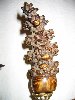
Just acquired my first legitimate older kris. It looks to be intact (except for the scabbard) but in poor shape. I would like to clean the blade and try to preserve the handle. As you can see the cord wrapping around the this totally shredded. I do believe the pommel is banati wood.
Would appreciate any thoughts on the kris and how I should go about preserving it or even restoring the hilt? |

|

|
|
24th March 2026, 10:44 AM
|
#2 |
|
Member
Join Date: Aug 2007
Location: Germany, Dortmund
Posts: 9,788
|
Hi Nathan,
Nice older 19th century kris!  But a challenge to restore it to former glory. The binding will be difficult to do, I am not able to do something like this. I have a kris in my own collection where a friend of mine had given it a new binding, maybe not the best one but adequate IMVHO. But a challenge to restore it to former glory. The binding will be difficult to do, I am not able to do something like this. I have a kris in my own collection where a friend of mine had given it a new binding, maybe not the best one but adequate IMVHO.The pommel seems to be indeed made from banati wood, this one I would clean with 000 steel wool, oiling it and giving it a polish with antique wax. The fittings are from silver? Good that they are all present. The scabbard I would also try to restore, I guess that it is soft wood? Good luck with this project, it would be nice when you would show the restore steps here.  Attached are pics of my one with the steps of the restoration. Regards, Detlef |
|
|
|
|
26th March 2026, 01:15 AM
|
#3 |
|
Member

Join Date: Mar 2005
Posts: 650
|
0000 not 000
wildwolberine,
Very nice kris you have there. It deserves the best restoration effort. Since Kiwi Wood Preen is no longer available, to clean the pommel I would start out with a toothbrush and Murphy’s Oil Soap. Get it as clean as you can with that and let it dry. If it still needs more attention, I would use a wood cleaner wax (or even Meguiar’s Automotive Cleaner Wax) and 0000 steel wool (I’m sure Sajen meant 0000 and not 000). Study the existing hilt wrap you have. It doesn’t look too complex. You should be able to come up with a close approximation. Cleaning the blade will be a bear though. Sincerely, RobT |
|
|
|
|
26th March 2026, 08:53 AM
|
#4 | |
|
Member
Join Date: Aug 2007
Location: Germany, Dortmund
Posts: 9,788
|
Quote:
 Sorry! Sorry!
|
|
|
|
|
|
31st March 2026, 05:51 AM
|
#5 |
|
Vikingsword Staff

Join Date: Dec 2004
Location: The Aussie Bush
Posts: 4,738
|
Hi ww:
Nice late 19th C Maguindanao kris you have for restoration. While the pommel could be banati wood covered with some grime it might also be kamagong, which is a darker wood and its grain does not have the chatoyancy of banati. Both banati and kumagong are considered "precious" woods within the local culture. You have received some good advice already. On heavily oxidized blades like this one, I prefer to start with 400 wet and dry sandpaper. It gives a faster clean of the surface oxidation (but don't remove all of it or you will scratch the surface of the stee)l. Then I switch to higher grades, such as 800 and 1200 grit to remove the remaining oxidation. Steel wool 0000 works well, but is slower. Remember too, that in the original culture these blades often had residual grinding and polishing marks — a mirror-like finish is a Western aesthetic and is not traditional in the host culture. I think over-polishing detracts from the original item and its value. The aim should just be to remove the surface oxidation (etching is optional). With respect to the hilt binding, beware of what looks simple! I have tried to emulate some of these "simple" bindings with limited success. My work has been rather clumsy (similar to what Sajen's example shows). Rattan is even harder. Fortunately, the original culture used even simpler wraps than shown on yours. Take a look at some examples in the archives here. Experiment carefully and practice on some wood doweling first. You can find black lacquered cord online. As far as restoring the scabbard, consider the "wingless" style used on late 19th/early 20th C kris. If you have some woodworking skills, this should be a relatively easy repair. Again, check the archives here and consult Robert Cato's book on Moro Swords where he discusses the different styles of Maguindanao scabbards. Good luck. You will learn a lot from working on this one. Regards, Ian. |
|
|
|
|
1st April 2026, 12:45 AM
|
#6 |
|
Member
Join Date: Mar 2005
Posts: 650
|
You're Already Half Way There
wildwolberine,
I would go for a full restoration of the sheath as it was originally. You already have what looks to be the entire front half to use as a template. I don’t know what your woodworking skills are but, as an amateur woodworker myself, this doesn’t appear to be a hard job at all. The only real difficulty I can see is matching the type of wood and especially matching the color. Sincerely, RobT |
|
|
|
 |
|
|


 Linear Mode

