![]() |
|
|
|
|
#1 |
|
Member
Join Date: Mar 2016
Location: Paris (France)
Posts: 432
|
I don't know, but the sickle shape and the handle made me think of Java.
But, to have it in my hands, the polishing of the blade also reminded me of Bali. In any case I am very glad you asked the question on the forum, because I would have liked to win it.... (But at least I'm glad it's in collection of a member of the forum).
|
|
|
|
|
|
#2 |
|
Member
Join Date: Sep 2005
Location: Paris
Posts: 21
|
Athanase, were you at the auction?
|
|
|
|
|
|
#3 |
|
Member
Join Date: Mar 2016
Location: Paris (France)
Posts: 432
|
On internet (at work
). At this auction there was far too much competition for me, I didn't have anything.
|
|
|
|
|
|
#4 |
|
Member
Join Date: Jun 2009
Posts: 1,307
|
Quite interesting.
In van Zonneveld's book there is a somewhat similar blade depicted and named as "Kudi Tranchang" from Bali on page 76. Regarding the name, please read the post #21 here: http://www.vikingsword.com/vb/showth...ight=tranchang I agree, that the blade has a strong Balinese flavor, yet the handle absolutely not. They look nice together, yet the combination is in some way cross-cultural. Similar handles we could find on Sulawesi, Java and Sumatra, perhaps even Malay Peninsula. |
|
|
|
|
|
#5 |
|
Member
Join Date: Sep 2005
Location: Paris
Posts: 21
|
I agree Gustav the pamor looks Balinese, and the blade shape does look similar to Zonneveld kudi, however the Zonneveled item is a balinese ceremonial axe with a much wider blade.
The hilt shape reminds me of the Aceh Co Jang, and interestingly the back of the blades have similar chiseling close to the hilt. |
|
|
|
|
|
#6 |
|
Keris forum moderator
Join Date: Aug 2006
Location: Nova Scotia
Posts: 7,261
|
Can someone tell me why this is a klewang?
|
|
|
|
|
|
#7 |
|
Member
Join Date: Jun 2009
Posts: 1,307
|
It isn't mainly the Pamor, which allows to think of Bali as the very possible origin of the blade.
As I wrote, such overall shape of handle is found in many places in SEAsia. Important - it's faceted, and such feature is more likely distinctive for Sulawesi and West Java. Yet I don't think it's the appropriate handle for this blade. |
|
|
|
|
|
#8 | |
|
Member
Join Date: Apr 2005
Posts: 3,255
|
Hello Dominique,
What are the total and blade length of your piece? Quote:
I'd also argue that the similarity of the hilt of your piece and the hulu tapa guda from northern Sumatra is spurious: It has the same function to keep the hand from slipping off the hilt; however, your piece does not show any stylistic key features that would indicate an origin from the greater Aceh region. Also the chiseling at the base of the blade is quite distinct: In your blade the base of the back of the blade has a protrusion which seems to correspond with the possible Garuda head/beak as found on most tiuk pengentas from Bali; also the decoration at the vertical base of the blade is typical Bali work as is the pamor. Regards, Kai |
|
|
|
|
|
|
#9 |
|
Member
Join Date: Sep 2005
Location: Paris
Posts: 21
|
Hi,
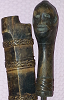
Thank you for your inputs. The blade length is 46cm, the hilth is 18cm. The blade is very sharp and sturdy. It does not seem to be recently refitted and the ferrule fits well the blade and the hilt. The hilt has 7 facets. There is a number (990) on the top of the hilt, which looks like an inventory number. I assume it was part of an old collection. The are similarities with the "Batek" page 339 of Keris di Lombok. Dominique |
|
|
|
![]() |
|
|