
|
 6th June 2016, 04:47 AM
|
#1 |
|
Vikingsword Staff

Join Date: Dec 2004
Location: The Aussie Bush
Posts: 4,738
|
 King Tut's dagger--a blade of meteoritic iron
A recent article (appended to this post as a PDF file) published in Meteoritic and Planetary Science makes a very strong case that a dagger found in King Tutankhamun's tomb in 1925 is actually made of iron from a meteor.
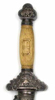
King Tut lived in the 14th C BCE at a time when Egyptian metallurgy was thought to be fairly rudimentary. Although iron ore was readily available to the Egyptians, there is no historical record of them smelting iron ore before about 500 BCE. Prior to that time, whatever iron they used appears to have come from meteors. As a result iron was even rarer than gold, and objects made of iron were reserved for kings and nobility. King Tut's dagger is a magnificent piece of craftsmanship, with iron work that is much more advanced than suspected for this time. The picture below of this knife comes from the same article: it shows a double edged, symmetrical blade with a hilt of gold and rock crystal. The sheath is gold. Not surprisingly, this dagger has raised substantial questions about the state of Egyptian metallurgy and iron work. The Egyptians of the time seem to have known the source of this iron, because they used an expression for it that means "iron from the sky." The article is worth reading for its historical perspectives about Egyptian metal crafts in the time of King Tut--it also happens to be pretty solid scientifically for those who are into metallurgy. Here is the Abstract of the article if you don't want to download it: Scholars have long discussed the introduction and spread of iron metallurgy in different civilizations. The sporadic use of iron has been reported in the Eastern Mediterranean area from the late Neolithic period to the Bronze Age. Despite the rare existence of smelted iron, it is generally assumed that early iron objects were produced from meteoritic iron. Nevertheless, the methods of working the metal, its use, and diffusion are contentious issues compromised by lack of detailed analysis. Since its discovery in 1925, the meteoritic origin of the iron dagger blade from the sarcophagus of the ancient Egyptian King Tutankhamun (14th C. BCE) has been the subject of debate and previous analyses yielded controversial results. We show that the composition of the blade (Fe plus 10.8 wt% Ni and 0.58 wt% Co), accurately determined through portable x-ray fluorescence spectrometry, strongly supports its meteoritic origin. In agreement with recent results of metallographic analysis of ancient iron artifacts from Gerzeh, our study confirms that ancient Egyptians attributed great value to meteoritic iron for the production of precious objects. Moreover, the high manufacturing quality of Tutankhamun’s dagger blade, in comparison with other simple-shaped meteoritic iron artifacts, suggests a significant mastery of ironworking in Tutankhamun’s time.Ian. Last edited by Ian; 7th June 2016 at 06:14 AM. Reason: Added abstract of the article |

|

|
|
6th June 2016, 10:42 AM
|
#2 |
|
Member
Join Date: Aug 2014
Location: Germany
Posts: 525
|
Thank you for the article.
Yes, this dagger is pretty strange. It is known since many decades, that this dagger is made from meteroid-iron, centuries before the smelting of iron in Egypt. But there is at least one huge problem! This dagger is laminated, very skillfully laminated. How in all the world the Egyptians could know how to fold steel if they are totally unexperienced with this material and technique? The making of a steel blade is totally different compared to a bronze sword. Meteroid iron is often very difficult to forge. Very very strange circumstances. Roland |
|
|
|
|
6th June 2016, 05:54 PM
|
#3 |
|
Vikingsword Staff
Join Date: Dec 2004
Location: The Aussie Bush
Posts: 4,738
|
Roland,
As you say, it is indeed a mystery as to how the Egyptians of that period knew how to manufacture such a dagger. The dating of the dagger to Tut's period is clearly established, and yet the technology used in manufacturing the blade is centuries before its time. The "alien origins" theorists would have a simple answer.   Ian. |
|
|
|
|
6th June 2016, 06:50 PM
|
#4 | |
|
Member

Join Date: Mar 2006
Location: Room 101, Glos. UK
Posts: 4,286
|
interesting google find:
Quote:
ref: LINKY the world is much stranger than we think. our histories are fragmented, especially back then. there were extensive trade networks around the WHOLE world well before we know. and even battery driven plating, and other technologies we in our smug world view look on as mysteries. bronze is cheap, easy to produce and cast and corrosion resistant, iron is slightly better than bronze as weaponry, if made correctly, but a whole lot more work to get right, thus very expensive. especially as it corrodes and goes back to the gods a whole lot faster than bronze. not much incentive to use it for more that expensive gifts until it became a lot more commercially viable & available. the hyksos conquests of northern egypt in 1700bc may have introduced the egyptians to iron, ramases battles against the hittites certainly did. the climate helped preserve tut's dagger, while the hittites,, in anatolia, left essentially no iron artifacts. 'nother linky Egypt:time line Last edited by kronckew; 6th June 2016 at 07:03 PM. |
|
|
|
|
|
6th June 2016, 09:34 PM
|
#5 | |
|
Member
Join Date: Aug 2006
Location: Heidelberg, Germany
Posts: 187
|
Quote:
|
|
|
|
|
|
6th June 2016, 09:44 PM
|
#6 |
|
Vikingsword Staff
Join Date: Dec 2004
Location: The Aussie Bush
Posts: 4,738
|
My main reason for posting the article on King Tut's dagger is that the data it presents--that the blade comes from meteoritic iron and shows a degree of ironwork more advanced than evidenced by other examples of Egyptian iron work from that period--was to emphasize that a scientific approach to analyzing the blade has resolved, as far as possible, the origins of the iron from which it was made. One item of debate has been settled.
There has indeed been much speculation about the origins of this knife and whether it may have been a gift from another culture. Whether the Hittites had more advanced knowledge of iron working is possible, but such examples are lacking. So we are largely left with conjecture. Separating facts from myths is difficult given the distance of time. Ian |
|
|
|
|
6th June 2016, 10:42 PM
|
#7 | |
|
Member
Join Date: Mar 2012
Posts: 422
|
Quote:
|
|
|
|
|
|
7th June 2016, 12:38 AM
|
#8 |
|
Member
Join Date: May 2006
Posts: 7,230
|
The nature of meteoritic material means that it must be laminated if it is to be used in a blade, except where it has been cut directly from the body of the meteorite, and in this case that does not appear to be so.
|
|
|
|
|
7th June 2016, 03:07 AM
|
#9 |
|
Member
Join Date: Mar 2012
Posts: 422
|
There are plenty of examples of non-laminated meteoric iron blades, notably cold-forged blades. However, those are usually small. I don't know of any the size of Tutankhamun's dagger (21cm long blade).
Reading further I find: the other meteoric iron objects from Tutankhamun's grave are cold-forged. Apparently the dagger is the exception. The dagger blade is also possibly (probably?) not Egyptian in origin, but might be one of the iron blades given to Amenhotep III (Tutankhamun's grandfather (probably)), by King Tushratta of the Mittanni. |
|
|
|
|
7th June 2016, 05:57 AM
|
#10 | |
|
Vikingsword Staff
Join Date: Dec 2004
Location: The Aussie Bush
Posts: 4,738
|
Quote:
|
|
|
|
|
|
7th June 2016, 06:12 AM
|
#11 | |||
|
Vikingsword Staff
Join Date: Dec 2004
Location: The Aussie Bush
Posts: 4,738
|
Quote:
Quote:
Quote:
|
|||
|
|
|
|
7th June 2016, 07:52 AM
|
#12 |
|
Member
Join Date: May 2006
Posts: 7,230
|
Yep, heaps of examples of blades from meteoritic material that has not been forge welded.
However, as I said:- "---except where it has been cut directly from the body of the meteorite---" But to make a blade from the material without welding it, you need a very good, compacted piece of meteorite, and the blade size is dictated by the size of the meteorite. With forge welding the limitation is not the size of the meteorite, but the skill of the smith. Actually, you don't "cold forge" it, you use stock removal techniques. |
|
|
|
|
7th June 2016, 09:23 AM
|
#13 |
|
Member
Join Date: Mar 2012
Posts: 422
|
Many are cold-forged (i.e., hammered on an anvil, at ambient temperature). The most studied ones are from Greenland, from the Cape York meteorite. For some Greenland blades, the only stock removal is the sharpening of the edge, while for others, the whole surface has been ground (distortion of the original structure shows it has been forged). There are also cold-forged telluric iron blades from Greenland.
The advantage of cold-forging compared with stock removal with no forging is that less iron is lost. The size is limited by the size of the meteorite, but this is a limit to the volume, and the length and/or width of the final blade can exceed that of the meteorite. The largest blades I know of made this way are 50mm long, so only a quarter of the length of the blade of Tutankhamun's dagger. AFAIK, they are made from small fragments of the meteorite that fell separately, rather than pieces removed from the main pieces of the meteorite. The Greenland telluric iron blades are smaller, since they start with smaller pieces, but, again, this is a limit to the volume. Whether or not a meteorite can be usefully cold-forged depends on the meteorite. Some will shatter, some are too hard, and some are malleable and can be cold-forged. For discussion of cold-forging of the Greenland meteoric iron, including modern experiments, see Buchwald and Mosdal, "Meteoritic Iron, Telluric Iron and Wrought Iron in Greenland": https://books.google.com.au/books?id...=PA17&lpg=PA17 For the largest of the Greenland blades, see Buchwald, "Iron and Steel in Ancient Times": https://books.google.com.au/books?id...=PA22&lpg=PA22 |
|
|
|
|
7th June 2016, 09:24 AM
|
#14 |
|
Member
Join Date: Aug 2014
Location: Germany
Posts: 525
|
I have two additional pictures.
The picture with the red arrow clearly shows signs of a lamination process. The other picture looks like that the dagger is differential hardened. The blade is much too perfect for the first few footsteps with a completely new technology. Roland |
|
|
|
|
7th June 2016, 10:01 AM
|
#15 |
|
Member
Join Date: May 2006
Posts: 7,230
|
Please accept my apologies Timo.
I was wrong. My comments were based upon what I have seen made from meteoritic material by modern knifemakers, I wasn't even thinking of use in ancient times, I do know that it was used, but have not studied its use in ancient times. Still, based upon my own experience in working with meteoritic material, which is not inconsiderable, I do find it very difficult to believe it can successfully cold forged --- but I suppose it does depend upon the meteorite. Just a thought Timo:- are we talking about cold forging, or cold work? I've just a done quick scan of the material you have supplied links to, and although I have picked up "cold work", I have not yet seen "cold forge". Cold forging means that you work the material at a black heat, in other words you bring it to a red heat, let the material lose its heat until it is black, then you work it with a hammer until it is cold. This technique is sometimes used to pack the edge of a blade. "Cold work" means bringing the material to the shape required by cutting or grinding. |
|
|
|
|
7th June 2016, 03:12 PM
|
#16 | |
|
Keris forum moderator
Join Date: Aug 2006
Location: Nova Scotia
Posts: 7,297
|
Quote:
"...the examples make it clear that i) iron meteorites may be forged at red heat to nails, horseshoes, hinges, swords, crowbars ploughshares, etc. to maximize weighs of a few kilograms ii) iron meteorites may be cold hammered to arrowheads, knives and other small objects with a maximum weight of a few tens of grams iii) massive iron meteorites have served as anvils for generations. Many of these have survived to our day and may be studied in various museums iv) iron meteorites do corrode in the terrestrial envirionment at the same rate as wrought iron..." The body of the text around figure 10 on this last link talks repeatedly about the work being shaped by "cold hammering". I don't know if this is the same as "cold forging", but it doesn't sound like simple stock removal to me. 
|
|
|
|
|
|
7th June 2016, 03:41 PM
|
#17 | |
|
Member
Join Date: Aug 2014
Location: Germany
Posts: 525
|
Quote:
I'm sure it is not the same. Cold hammering means imho (!) the improving of the cutting edge of a finished bronze sword to increase the cutting performance. This work will be done either without or just a tiny bit of deformation. It is absolutely impossible to forge cold iron. One can hammering the steel until it is hot, but one cannot forge steel at room temperature! Otherwise one would destroy the crystalline structure of the steel or iron. One can cut a blade like structure from a meteroid, grinding and cold hammering the edge a little bit. But this have nothing to do with forging! |
|
|
|
|
|
7th June 2016, 07:00 PM
|
#18 | |
|
Keris forum moderator
Join Date: Aug 2006
Location: Nova Scotia
Posts: 7,297
|
Quote:
|
|
|
|
|
|
7th June 2016, 09:38 PM
|
#19 |
|
Member
Join Date: Dec 2004
Location: Philadelphia, Pennsylvania, USA
Posts: 54
|
When I first read about Tut's dagger, I was reminded of an old academic paper that I purchased at the Smithsonian Institute maybe 20 years ago: "Two Early Chinese Bronze Weapons with Meteoric Iron Blades"; Gettens, Clarke, and Chase; 1971. I have it in front of me; it still has the 99-cent price tag from when I discovered it in the Smithsonian's gift shop's discount bin. Not exactly a best-seller.
After a cursory search, I see it's available online: https://www.asia.si.edu/research/dow...%20Weapons.pdf The paper is very technical in places, but the upshot is that the Freer Gallery of the Smithsonian owns two weapons, a "broad axe" and a "dagger axe", both dating from circa 1000 BCE and incorporating both bronze and meteoric iron in their construction. I realize Tut predates these weapons by about four centuries, but I find it interesting that two ancient cultures in different parts of the world, understood the importance of meteoric iron and learned how to incorporate it into their current technology. |
|
|
|
|
7th June 2016, 09:48 PM
|
#20 | ||
|
Member
Join Date: Mar 2012
Posts: 422
|
Quote:
I've done it; other people have done it. It is absolutely possible. A simple example: https://www.youtube.com/watch?v=N66-n3FJ5Vw Quote:
It does lead to work-hardening, which (if you don't stop and anneal the piece) will limit how much you can work it, especially how thin you can make it. These two points (needs more force to deform, work-hardening) plus not being able to weld as part of the process are why, for general purpose forging, you hot-forge. But hot-forging generally being better doesn't mean that cold-forging is impossible. If you lack fuel, it might be the only option. If you can start with stock that doesn't need to be worked much to reach its final shape, then it can be a good option even today (forming steel cold in a metal press, panel beating, cold-peening rivets and sword tangs are examples of this). I haven't tried cold-forging with annealing, so can't comment on effect from experience. In principle, it should work. Cold-forging, with intermediate annealing, is the natural way that a redsmith/coppersmith who knows nothing of iron will try to forge iron, since it's the way that copper and copper alloys are forged. |
||
|
|
|
|
7th June 2016, 10:06 PM
|
#21 | ||
|
Member
Join Date: Mar 2012
Posts: 422
|
Quote:
Similar problems with cold-forging telluric iron. There are huge pieces of telluric iron in Greenland that weren't used for forging (useful as anvils, though), since high carbon content (they're basically cast iron in composition) makes the iron impossible to work (at least cold). Quote:
The Greenland iron is worked at room temperature, without being heated. In the modern experiments reported by Buchwald and Mosdal (pg 18), the temperature never exceeded 50C (the piece being heated by the working). Room temperature, anvil and hammer. Especially for small pieces of meteorite (and telluric iron), the forging was often a simple flattening to as thin a piece as feasible, with the cutting edge then sharpened by grinding. The telluric iron blades were usually still very small after flattening, and would be mounted along a support to produce a saw-like knife. Last edited by Timo Nieminen; 8th June 2016 at 06:48 AM. |
||
|
|
|
|
7th June 2016, 11:52 PM
|
#22 | |||
|
Member
Join Date: Mar 2012
Posts: 422
|
Two questions:
Quote:
Laminated, in the sense of being welded together from different irons, is possible (and might explain why the 1995 XRF measurements gave a much lower nickel content - I should look where the recent XRF measurements were taken on the blade (it's in the supplementary material for the paper)). Quote:
I'd be really surprised if the carbon content is high enough for differential hardening. A lamination line would be a more likely explanation. Quote:
Perhaps not a completely new technology. The Alacahöyük dagger (from Anatolia) is about 1000 years older than Tutankhamun's dagger. Too corroded to know if the workmanship is similar. High nickel -> meteoric iron. https://commons.wikimedia.org/wiki/F...Alacahoyuk.jpg |
|||
|
|
|
|
8th June 2016, 04:46 AM
|
#23 |
|
Member
Join Date: Feb 2014
Posts: 468
|
A few questions that are nagging at me:
Can iron be worked at room temperatures with tools that are softer than iron? Does the heat-treating that any meteorite receives during its atmospheric entry have any consequences affecting its characteristics, that would not obtain in ordinary terrestrial iron? I apologise in advance for my general ignorance of the subject at hand. |
|
|
|
|
8th June 2016, 06:40 AM
|
#24 | ||
|
Member
Join Date: Mar 2012
Posts: 422
|
Quote:
Quote:
|
||
|
|
|
|
8th June 2016, 10:51 AM
|
#25 |
|
Member
Join Date: May 2006
Posts: 7,230
|
After reading more from the sources that Timo has indicated, as well as a number of other on-line sources, I'm inclined to agree that a blade could be forged cold from meteoritic material, but with the qualification that the meteoritic material would need to be of the correct composition to permit this forging, and if only forging was to be used, the shape and size of the material would need to be very close to the finished article.
There can never be any dispute about the cold forging of simple blades from iron, or preferably mild steel, this is a standard blacksmithing technique. A careful reading of the Buchwald & Mosdel link indicates that the material used in the Greenland blades was indeed capable of being cold hammered, and that it was quite thin in the first place, probably fragments that had split off from the main body of the meteorite. In a previous post to this thread I used the term "stock removal". We usually tend to think of stock removal in the modern terms of files and mechanical grinders, but stock removal is actually the reduction of any large piece of material by cold removal of some of the original body of material. This can be achieved by splitting or by grinding with a stone or wet sand and wood. The Buchwald & Mosdel work does seem to indicate that stock removal did take place, either by the splitting off of meteor fragments at the time of impact (spallation), or by the human agency of splitting off fragments. It also seems that quite high temperatures were at least sometimes used (P.16). Here is a link to another source that is well worth attention:- http://www.ironfromthesky.org/?p=310 Once we understand that the composition of the meteorite used in the Greenland blades was such that it permitted a degree of shaping by cold hammering, and that the fragments of meteorite that were turned into blades were quite small and thin to begin with, the entire Greenland blade matter becomes clear. However, there is a vast difference between the Greenland blades and the King Tut blade. The King Tut blade is a large, serious, very well made blade, something that without prior knowledge could very well be attributed to a much later time. I believe that it will eventually be confirmed that this blade is of forge welded construction. |
|
|
|
|
8th June 2016, 02:06 PM
|
#26 | ||
|
Member
Join Date: Aug 2014
Location: Germany
Posts: 525
|
Quote:
Different Nations, different definitions. "Work hardening, also known as strain hardening or cold working, is the strengthening of a metal by plastic deformation. This strengthening occurs because of dislocation movements and dislocation generation within the crystal structure of the material." I apologize, but in Germany this is per definition no forging in the narrower sense. Quote:
Roland Last edited by Roland_M; 8th June 2016 at 02:33 PM. |
||
|
|
|
|
8th June 2016, 02:23 PM
|
#27 | |
|
Member
Join Date: Mar 2012
Posts: 422
|
Quote:
* The best information I've been able to find is that it isn't cold-forged (unlike the other iron objects from the tomb). |
|
|
|
|
|
8th June 2016, 02:51 PM
|
#28 |
|
Member
Join Date: May 2006
Posts: 7,230
|
Timo, have you ever tried to forge weld?
I was taught basic blacksmithing by a man who came out of his apprenticeship in 1947, in a NSW country town. He was one of the last traditionally trained smiths in Australia. He taught me to forge weld iron and mild steel. At that time (1980) I was unable to find anybody in the greater Sydney area who could teach me to forge weld iron with high carbon steel or with nickel. This included the very few tech college teachers who were teaching blacksmithing at that time. In the 19th century text books that I was using back then, mention was made that in most towns in England where there were several smiths, one smith was usually recognised as the welding specialist and he accepted welding jobs from the other smiths in his area. Forge welding in coke or charcoal is not at all easy. It took me about 12 months of trial and error to teach myself to weld iron + nickel + high carbon steel , in the forge. Subsequently I taught a number of other people. The step from ordinary forge work to welding in the forge is a very big step, and the step from welding iron to welding materials with different weld temperatures is immense. To weld meteoritic material in the forge is a step further again. These days most people who can forge weld are using gas forges, and this welding is about as difficult as making a chocolate cake, but welding in a traditional forge is not something that is easy to do. |
|
|
|
|
8th June 2016, 09:26 PM
|
#29 | |
|
Keris forum moderator
Join Date: Aug 2006
Location: Nova Scotia
Posts: 7,297
|
Quote:
"His tomb was robbed at least twice in antiquity, but based on the items taken (including perishable oils and perfumes) and the evidence of restoration of the tomb after the intrusions, it seems clear that these robberies took place within several months at most of the initial burial. Eventually, the location of the tomb was lost because it had come to be buried by stone chips from subsequent tombs, either dumped there or washed there by floods. In the years that followed, some huts for workers were built over the tomb entrance, clearly without anyone's knowing what lay beneath. When at the end of the 20th Dynasty the Valley of the Kings burial sites were systematically dismantled, Tutankhamun's tomb was overlooked, presumably because knowledge of it had been lost, and his name may have been forgotten." As to whether this dagger was made by the Egyptians or a gift from another civilization, it should be considered that the reason we are hearing about this now is because the latest XRF measurements have identified the make-up of the blade to be identical to the make-up of a meteorite found near the Kharga Oasis, not far from the tomb itself. I suppose it is possible that by coincidence a meteorite that fell in a distant land was the source material for this blade, but again, Occam's Razor would suggest that the likeliest answer is that the dagger was made near when that material was found. |
|
|
|
|
|
8th June 2016, 10:13 PM
|
#30 | ||
|
Member
Join Date: Mar 2012
Posts: 422
|
Quote:
Is it a big inventive step from hot forging to welding? At welding temperatures, iron/steel is sticky. (I've had to remove tools with hammers, and that's just accidental sticking, not deliberate welding.) I don't think it's extraordinary to deliberately investigate welding iron after noticing that. Quote:
Of course, that's 12 months starting with knowing how to forge weld already. But you say that's an immense step from welding iron, compared to a merely big step from forging to forge welding iron. I haven't tried it. |
||
|
|
|
 |
|
|


 Linear Mode

