
|
 4th December 2013, 10:46 PM
|
#1 |
|
Member
Join Date: Nov 2013
Posts: 456
|
 Takouba with 4 fullers
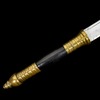
The worst thing about spending time on this forum is that you see all sorts of cool things you can't afford. Specifically, I really took a liking to straight North African swords like the Takouba and Kaskara, and I decided to get a cheap one. Rather than going with E-bay and getting a tourist piece, I got this one off Oriental Arms. As you can see it's in pretty rough shape. One side has 4 fullers, the other side 3 and they're definitely ground not forged. It has the half moons on both sides, but rather than a face it just has a squiggle.
There are some faint striations on the edge towards the top which didn't come out in any of these pictures. There's a ding or two in the edge as well. The blade has good flex to it. The handle is raw metal, I assume it was encased in leather at some point, and it's stuffed with fabric. The sheath is pretty ratty, and the end of it is actually missing. The baldric is some sort of fabric, also in rough condition, and the d rings holding it in place look like rusty iron. Is there any way to date the blade or narrow down what ethnic group it originated from? It's obviously seen a hard life and there's not much left of it, but at least I'm reasonable sure it isn't a tourist piece. |

|

|
|
5th December 2013, 07:46 AM
|
#2 | |
|
Member
Join Date: Mar 2010
Location: Olomouc
Posts: 1,720
|
Quote:
Your example is fairly recent, I would guess made in it's entirety in the last 30 odd years. The scabbard appears Tuareg to me. |
|
|
|
|
|
5th December 2013, 05:59 PM
|
#3 |
|
Member
Join Date: Nov 2013
Posts: 456
|
Thank you for the information. I'm suprised it's so recent considering how worn out everything is, but I guess the desert ages things quickly. I wanted an older "weapon grade" takouba rather than one just for wearing, so I guess I'll keep looking.
|
|
|
|
|
6th December 2013, 08:55 AM
|
#4 | |
|
Member
Join Date: Mar 2010
Location: Olomouc
Posts: 1,720
|
Quote:
Generally speaking though, this sort of blade indicates a scrap steel source like a car spring. Which is not to say it's a bad blade. Even the more modern swords are occasionally used. I've seen news stories in Nigeria in the last 5 years about the occasional incident with a Fulani herder using their sword. So I wouldn't be bothered by it being a mid 20th century item. I'll send you a PM later on. |
|
|
|
|
|
6th December 2013, 04:17 PM
|
#5 |
|
Arms Historian

Join Date: Dec 2004
Location: Route 66
Posts: 10,871
|
Extremely well noted Iain, and I'm always glad you bring up these salient details on takouba (which of course apply to kaskara in Sudan) as far as their actual modern use. I have always considered the unfortunate term 'tourist' or 'souvenier' often misapplied with many of these swords, especially so many which are quite recent relatively.
There are few who have entered into the depth of study toward the takouba as you have, and as you have shown on your site, and in your collection, the continuous tradition of these swords covers not only generations, but centuries. What is phenomenal is that even in these modern times, the takouba and kaskara remain viable weapons among tribal peoples. As you note, even the modern examples of these swords are commonly purchased by locals, and as far as their becoming 'tourist' items, individuals are often inclined to sell the sword they have to inquiring 'guests. They then simply obtain another. Therefore these remain authentic examples 'ethnographically', and while they may not have the often colorful history associated with the treasured blades which have been passed through generations and through desert trade channels, they are still sound representative and fascinating examples. |
|
|
|
|
6th December 2013, 04:30 PM
|
#6 |
|
Member
Join Date: Nov 2013
Posts: 456
|
I think the scabbard mounts are iron or steel underneath all that brown rust. They may have been painted black at some time, although it almost looks like forge scale or maybe it's just corrosion.
Thank you for your reassurances. I'm pleased to hear the blade is most likely made of spring steel. I have several modern khukris/goloks/parangs made from such and they're all exceptionally tough blades. The edge towards the tip is sharp enough to catch on my fingernail, and I will admit I swung it at a cardboard box and it sliced right through. I promise I won't do that again. Do you think the hilt was once covered in leather? It looks like it was painted black so I wonder if it was always exposed. Is it typical for the crossguard to be stuffed with yarn or fabric? |
|
|
|
|
7th December 2013, 10:51 AM
|
#7 | ||
|
Member
Join Date: Mar 2010
Location: Olomouc
Posts: 1,720
|
Quote:
Quote:
With regards to the brass I meant the suspension rings or triangles. You'll be best placed to judge the blade having it in hand, but some of the recent takouba I've seen and handled certainly don't have bad blades in terms of toughness and holding an edge. The hilt would have been leather covered - grip and guard. It is not unusual for the interior of the guard to be stuffed with burlap or similar material. This is common on pieces where the guard is a couple pieces of steel folded around the blade, rather than the older, boxier construction. However this style of construction is only seen on very old mounts. Here's a 19th century example I used to own showing the same thing. 
|
||
|
|
|
|
9th December 2013, 06:21 PM
|
#8 |
|
Member
Join Date: Nov 2013
Posts: 456
|
That makes perfect sense, thank you. I do appreciate that you guys are world class experts and come here to discuss exemplar blades, yet are willing to take time to educate us newbies on more mundane examples such as mine.
Two final questions on this sword: it's very flexible, like a machete. Not surprising if this was made from spring steel, but I expected a fighting sword to be a little more rigid. Are older ones this flexible, or just modern ones like mine? Lastly, I've been going through takouba.org and I can't find any other takoubas that have a different number of fullers on each side like mine (3 on one side 4 on the other). Is this uncommon? |
|
|
|
|
9th December 2013, 08:14 PM
|
#9 | |
|
Member
Join Date: Mar 2010
Location: Olomouc
Posts: 1,720
|
Quote:
About the flexibility, yes, newer pieces do often have more flex. However... That said one of my oldest pieces (81) has an extremely flexible European blade. That's perhaps more of an exception though, most older blades are fairly stiff, as are some older native blades I've had/handled. Still, I think the attribute of flexibility is something that was desired and simply easier to acquire with modern steels. |
|
|
|
|
 |
|
|


 Linear Mode

