
|
 18th February 2013, 01:41 AM
|
#31 | ||||
|
Member
Join Date: Oct 2009
Posts: 171
|

Quote:
Quote:
Quote:
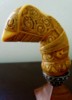
Attached were a series of pictures, where I believe would assist you in the further effort of it's ID. In the first pix I've highlighted the dots on the bottom and on the surface of the hilt, for easier identification. Quote:

|
||||

|

|
|
18th February 2013, 01:43 AM
|
#32 | |
|
Member
Join Date: Oct 2009
Posts: 171
|
Quote:
Perhaps I would own as good & as much as yours, one day... 
|
|
|
|
|
|
18th February 2013, 06:44 AM
|
#33 |
|
Member

Join Date: Jul 2012
Location: Mother North
Posts: 189
|
Damn, that's some strange stuff.... With the last photo, I must admit, that I am not able to ID it as being anything other than hippopotamus ivory. Maybe we are indeed looking at the very core of the tusk in cross section, when viewing your hilt from the pommel end. The layers and angle of the line of spots certainly fits...
That would mean that the hollow canal along the tusk core has been completely crushed by the dentine and now totally reduced to these little pin-prick impurities (spots in a row) we see. That's something I've never seen before, but then again freak incidents happen all the time in nature. -perhaps it happens once a hippo grows old enough, as the dentine layers keep packing on...? Would be interesting to see a series of tusk cross sections lined up according to the age of the source animal. Mosha, don't worry about what people call it. I deal with it on a regular basis too. Common people rarely know the exact scientific names of what they have. Unfortunately popular names are the scourge of useful investigation. In regards to your question. Horn is for instance what cattle, antilopes and rhinoceros grow. They are composed of keratin - the same materials that make up hair, claws and nails. Teeth are made up of dentine and enamel. The males (in most cases) of certain species of animals grow a particular set of large teeth made for combat - actual or ritual/demonstration - to determine their position in the group and predator deterrence (same thing as the above animals use their horn for). For example Elephant, narwhal and hippo. These particular teeth we call tusks. Getting back to your badik. Do you know if the hilt has attained this color by handling over time (patina) or has it been dyed in tea or another substance? Tea dying of ivory is something I would really like to learn more about. I myself, am a sucker for the warmer, more amber colors of ivory. - your's above is delicious! Thanks for the extra pics, they were very illuminating! All the best, - Thor |
|
|
|
|
18th February 2013, 06:45 AM
|
#34 |
|
Member
Join Date: Jul 2012
Location: Mother North
Posts: 189
|
Oh yeah, and Detlef - that makes two!
 ...when we get to three I'll bake you a cake when we meet sometime! 
|
|
|
|
|
18th February 2013, 04:30 PM
|
#35 | |
|
Member
Join Date: Aug 2007
Location: Germany, Dortmund
Posts: 9,788
|
Quote:
|
|
|
|
|
|
18th February 2013, 04:38 PM
|
#36 | |
|
Member
Join Date: Aug 2007
Location: Germany, Dortmund
Posts: 9,788
|
Quote:
Regards, Detlef |
|
|
|
|
|
19th February 2013, 12:11 PM
|
#37 | ||
|
Member
Join Date: Oct 2009
Posts: 171
|
Quote:
Quote:
I think the badik hilt in question here has turned brownish / golden on the area where the finger or palm would be placed. Noted the uneven slight yellowish that appears on some spot, vertically. I has one keris hilt with a suspected tea-dyeing treatment, where a straight line of golden tone was present, as if the hilt was partially submerged, heads up. Will post the pix later. Thanks Thor for enlighten me up in this segment...it is not easy to pick up and tell this-and-that ivory on the go, but with your knowledge and input I think we should be able to do that soon
|
||
|
|
|
|
19th February 2013, 04:07 PM
|
#38 | |
|
Member
Join Date: Jul 2012
Location: Mother North
Posts: 189
|
Quote:
I asked a colleague today btw, if he knew whether hippo tusks grow continually through the life of the animal and even though he wasn't sure, he pointed out a supporting fact that I hadn't considered: When the hippopotamus closes it mouth, the apical surface of the tusks in the lower jaw grind against those of the tusks in the upper jaw, perpetually wearing down the tusks from the distal end. This taken into consideration, it would make highly sense for the tusks to keep on growing and renewing throughout the life of the animal. I found a picture of a hippo skull where you can maybe get an idea of the tusks grinding against eachother: Last edited by T. Koch; 19th February 2013 at 04:23 PM. |
|
|
|
|
|
19th February 2013, 04:18 PM
|
#39 |
|
Member
Join Date: Jul 2012
Location: Mother North
Posts: 189
|
Here is the standard reference picture for a hippo tusk in cross section. Normally you would see a straight line of dots appearing in an ivory piece that has been cut from lengthwise down along the left and right borders of the TIZ.
If hippo tusks indeed grow throughout the life of the animal, my guess is that your piece came from an old hippo where the continuous addition of the lamellar dentine layers over time has completely "crushed" the TIZ and reduced it to the series of dots we see from the pommel end. Notice how the angle of dots in your hilt approximately fits with the shape of the TIZ? The picture also clearly shows the laminations. It could also just be a freak - a deviation from the norm, where an animal has been born without a prominent TIZ. I don't know - but now I'm certainly dead curious to find out! Regarding the tea staining, I'm sorry but can't answer you. I don't know anything about it but would love to learn more! Where was it done, how exactly, how culturally widespread, since when, etc. I just know I like the color. All the best, - Thor |
|
|
|
|
20th February 2013, 10:41 AM
|
#40 | |
|
Member
Join Date: Oct 2009
Posts: 171
|
Quote:
However some of my kerises hilts were also producing the similar tiny dots over the TIz. Then would it be a hippo tusks as well? Generally it was touted as "sea ivory" over here, and the main indicator is the tiny dots along the TIZ, if that was ever the TIZ. Was marine ivory (walrus, sperm whale etc) doesn't have TIZ? Last edited by Moshah; 20th February 2013 at 10:55 AM. |
|
|
|
|
|
20th February 2013, 10:57 AM
|
#41 |
|
Member
Join Date: Oct 2009
Posts: 171
|
I'm sorry. The pix attachment seems to get haywire a little bit but I've already arrange it in order during the posting process...
 It is basically three hilts, with hilt # (b) supposedly closed up on the tiny dots on the TIZ... |
|
|
|
|
22nd February 2013, 12:38 AM
|
#42 |
|
Member
Join Date: Dec 2004
Posts: 125
|
This discussion has taken an interesting tangent...
I'm no expert by any means but I did want to raise one other alternate theory. I have seen unworked "gigi" in Kelantan and Pattani and it doesn't resemble at all the hippo ivory I've seen. Rather it was represented to me as walrus tusk (gigi singa laut). Based on this experience I've always believed that gigi = walrus ivory. Comparatively, you see a lot of "gigi" in Pattani, Kelantan and Terengganu. There must have been a reliable and fairly abundant source, but the Malay world's ties with tropical Africa were pretty distant. That's not to say that some hippo ivory didn't make it there but it is very rare IMO, having as it must to travel through the traditional trading route along the African and Iranian coast, through India and then only making the jump to Sumatra, Kedah then overland (or later, through Singapore). I've only seen one hilt in Kelantan that I'm fairly confident is hippo...this is based on comparison with photos of Persian khanjar hilts I've seen. However with the walrus hypothesis you may have a source for the material. Its been reported that in the 18th and 19th centuries, American whalers sometimes wintered by sailing a loop down into the S. China Sea, following the coast of Vietnam and the Malay Peninsula before turning back east along the N. Borneo coast. They brought with them mostly whale bone and hippo ivory to trade for supplies and probably some exotics to bring home (some to the Peabody Essex apparently ) . Popular tradition in Kelantan is that the gigi was bought from American sailors.Anyway, perhaps someone with more expertise on the material side can do some digging and see if they can find comparisons to walrus ivory? Also, as an aside...another sea mammal here in Southeast Asia worth looking at is the dugong or sea cow. I was told by the carvers though that dugong ivory is too small to make proper "hulu gigi". Also, dugong are very rare, shy creatures which doesn't jibe with the huge supply needed to make all those gigi hilts. I've seen some badik hilts that were said to be dugong though. |
|
|
|
|
22nd February 2013, 08:52 AM
|
#43 | |||
|
Member
Join Date: Apr 2005
Posts: 3,255
|
Hello Dave,
Quote:
Quote:
) would tentatively assign to being of hippo origin while walrus seems to be quite rare; in Ottoman, Persian and Indian hilts walrus is much more common.Walrus tusks have a prominent inner core that exhibits a distinct mottled pattern upon staining or developing patina. Quote:
Are spermwhale tooth also mentioned in those accounts? While these are usually too small for carving the fairly large N Malay keris hilts, they may be the main source for those pieces that are locally identified as dugong. Regards, Kai |
|||
|
|
|
|
22nd February 2013, 09:42 AM
|
#44 | |
|
Member
Join Date: Oct 2009
Posts: 171
|
Quote:
Of course the poor dugong mentioned above was rather small, but perhaps the dugongs / sea cows of those days were fairly big as to provide enough sources for those massive pekaka hilts? It happen to the tigers and lions too, whereas now you could hardly see them raised up as big a size as their predecessors... |
|
|
|
|
|
22nd February 2013, 10:10 AM
|
#45 | |
|
Member
Join Date: Apr 2005
Posts: 3,255
|
Hello Moshah,
Quote:
Have a look at this recent thread and another one discussing dugong. Regards, Kai |
|
|
|
|
|
22nd February 2013, 04:26 PM
|
#46 |
|
Member
Join Date: Jul 2012
Location: Mother North
Posts: 189
|
Hi Mosha,
Wow, thanks for the extra pictures! My estimate in all three cases is hippopotamus - again due to the presence of both these concentric laminations as well as the angular dots. - In no. 2 of the interstitial cavity is even visible (still there?) - cool! The hilts are very beautiful - if you ever think of selling no. 1 - let me know. Sperm whale (Physeter macrocephalus) teeth don't have a central cavity like a TIZ but do have concentric laminations. These are formed tighter together than those of hippo however, and the ivory itself is very hard and dense. I enclose a couple of pictures I've taken from the collection of Copenhagen Zoological Museum. The first is of an average sperm whale tooth: about 12-15 cm long and 100 - 150 g. Notice that the overall shape would fit quite well with some keris hilts, although I've never had a confirmed specimen in hand myself. As I recently showed in a thread on Sikin panjang the teeth can grow much bigger: http://www.vikingsword.com/vb/showpo...0&postcount=15 The second picture is of a sperm whale tooth split longitudinally and then treated with acid, so as to better display the laminations. Notice how little space the pulp cavity actually takes up. This is where the nerves and vascular system connects with the tooth. Note also, that many other whales have teeth. Most of them are however, in spite of the whales themselves growing rather large, only a couple of cm., but there are other species like the killer whale Orcinus orca, which also produce teeth of a significant size. I've found this article which describes the presence of 29(!) different species of whales in Indonesian waters: http://www.repository.naturalis.nl/document/149116 The six species from Balaenopteridae are irrelevant to us, as they grow baleen and not teeth. Of the other mentioned species, I know only that the killer- and sperm whales grow teeth so large, that they could be considered useful in our context - the rest I am unsure about. Would be very interesting to find out. Interestingly the article also describes the presence of whaling in Indonesian history as well as the contemporary level of hunting that has been performed on the species. It mentions that 612 sperm whales where taken from 1959 - 1994 from Lembata Island only - so the source for sperm whale ivory certainly seems to have been there. Regarding walrus tusks, please see my next reply below. Best wishes, - Thor |
|
|
|
|
22nd February 2013, 05:56 PM
|
#47 |
|
Member
Join Date: Jul 2012
Location: Mother North
Posts: 189
|
Hi DAHenkel,
I completely share your skepticism regarding the use of hippopotamus ivory in SEA, especially considering how relatively common they seem to be among ivory hilts. I have no idea... I am just relating to the morphology of the ivory itself and given the characteristics displayed, there are just not really any local options. I too find it absolutely mind-boggling that this trade wouldn't have been described in the literature somewhere. Regarding walrus tusk as a possible source, it is true when kai speaks about the characteristics of the inner core composed of osteodentine. It looks a bit like boiled rice. However, walrus tusks on old bulls grow really large and the diameter huge. -I've seen ones where the thickness of the layers surrounding the core was easily 5 - 7 cm. Also, the core does not extend to the tip. If walrus tusk is carved in such a way that the piece contains no core, we lose this identifying character. Please see attachment for the standard walrus tusk cross-section photo. The layers around the core consists mainly of dentine and a - sometimes rather thick - surrounding layer of cementum. Because of the way they are deposited, these can show a laminar structure in cross section, similar to that of the hippo. With age, these layers will tend to crack lengthwise down the tusk and radially in cross-section (as seen in the photo) I've sometimes, although on very few occasions, seen these cracks overgrow again and form small inclusions along them giving the appearance of "dots in a row". However, because of the structure of the walrus tusk, these dots will lie on a straight line as opposed to in an angle and they will appear perpendicular to the concentric laminations, as opposed to wedged in between them, as is apparent in Mosha's hilts above. I am not disregarding walrus as a possible source for keris hilts - compared to most of you guys I've seen very few hilts in my life. I just don't believe it is the source material in the examples presented above. All the best, - Thor Last edited by T. Koch; 23rd February 2013 at 08:28 AM. |
|
|
|
|
23rd February 2013, 03:53 PM
|
#48 | |
|
Member
Join Date: Aug 2007
Location: Germany, Dortmund
Posts: 9,788
|
Quote:
Agree with Kai and Thor, to my opinion the shown keris hilts are from hippo ivory. Walrus ivory is like Kai described, here three pictures from walrus ivory taken from other threads. I have seen only very few keris hilts worked from walrus ivory. Regards, Detlef |
|
|
|
|
|
26th February 2013, 12:18 PM
|
#49 | |
|
Member
Join Date: Oct 2009
Posts: 171
|
Quote:
Yup the cavity is still there in hilt # 2. Previously I have tried to foolishly drop the superglue in it, just for precaution, until it pools in the cavity and dried. I think I've resolves the issue but after a week the residues gone and the cavity is back! Enclosed were extra pix for hilt # 1. The edges of this particular hilt tend to be quite transparent a bit (see the fin of the pekaka on hilt 1 (d) example & the nose on hilt 1 (a) I've posted beforehand.), unlike any other gigi hilt I have had. Do you have any theory for that? Regards, Moshah Last edited by Moshah; 26th February 2013 at 12:28 PM. Reason: adding some info |
|
|
|
|
|
26th February 2013, 12:21 PM
|
#50 | |
|
Member
Join Date: Oct 2009
Posts: 171
|
Quote:
BTW, do you have the suspected walrus ivory keris hilt's pix? Did it bear resemblances as the material of those hilts you've just posted? Thanks. Moshah |
|
|
|
|
|
26th February 2013, 12:26 PM
|
#51 | |
|
Member
Join Date: Oct 2009
Posts: 171
|
Quote:
BTW attached were extra pix of hilt # 3, the full built and close up. I don't know what happen but it looks like he's having a bad measles there - something I haven't see on my other gigi hilts. Perhaps a different kind of tusk / ivory, as I don't think this measle-thingy can be called patinated, isn't it?Regards, Moshah |
|
|
|
|
|
26th February 2013, 03:58 PM
|
#52 |
|
Member
Join Date: Jul 2012
Location: Mother North
Posts: 189
|
Hi Mosha,
I'm not sure, but would think it could be because the nose is carved from the outer layer of cementum It also makes sense as it seems to be the most extreme part of the little guy. The transparency of the nose is what makes him so cute! The "mis"-colored one in the bottom pic is the same material as the others, IMO. Sometimes ivory just ages more beautifully than in other cases. It's the same if you look at the walrus hilts above - some become golden and lustrous with time while others become grey and 'dirty' looking. I guess it depends on what kind of life the material has had and which kind of environment it's been stored in. For this reason I in some cases personally find pieces of antler or bone more attractive than some pieces of ivory. I really love a warm and golden color and the aesthetic expression is more important to me in a piece, than the type of material. I've found a new pekaka hilt in walrus ivory for you, but the photo is from a dealers page, so I'll send you the link in a pm. We're not allowed to publically post pictures of stuff for sale, even if we don't reveal the source of the photo ...right? Take care, - Thor |
|
|
|
|
26th February 2013, 07:16 PM
|
#53 | |
|
Member
Join Date: Aug 2007
Location: Germany, Dortmund
Posts: 9,788
|
Quote:
|
|
|
|
|
|
26th February 2013, 07:19 PM
|
#54 | |
|
Member
Join Date: Aug 2007
Location: Germany, Dortmund
Posts: 9,788
|
Quote:
Regards, Detlef |
|
|
|
|
|
26th February 2013, 09:11 PM
|
#55 |
|
Member
Join Date: Apr 2005
Posts: 3,255
|
Thanks, Detlef, that would be great to see both hilts here!
Regards, Kai |
|
|
|
|
26th February 2013, 09:13 PM
|
#56 | |
|
Member
Join Date: Apr 2005
Posts: 3,255
|
Hello Thor,
Quote:
Regards, Kai |
|
|
|
|
|
26th February 2013, 10:33 PM
|
#57 | |
|
Member
Join Date: Apr 2005
Posts: 3,255
|
Thanks for the extra pics, Moshah!
Quote:
From the pics, the tip of the beak almost looks like a repair while the rest of the TIZ is obviously fine despite the unusual choice of placing it that close to the edge of the piece - looks like the carver was hoping to avoid including it but ran out of material... Regards, Kai |
|
|
|
|
|
28th February 2013, 12:51 PM
|
#58 | ||
|
Member
Join Date: Oct 2009
Posts: 171
|
Quote:
Quote:
Since this material was dearly prized back then, I believe the carver's intention was to make the most from the chunk of material he got. Rightfully they were skilled artisan as well, as they wouldn't rush the process for $$$, unlike these days. Regards, Moshah |
||
|
|
|
|
28th February 2013, 07:06 PM
|
#59 | |
|
Member
Join Date: Aug 2007
Location: Germany, Dortmund
Posts: 9,788
|
Quote:
|
|
|
|
|
|
28th February 2013, 07:18 PM
|
#60 | |
|
Member
Join Date: Aug 2007
Location: Germany, Dortmund
Posts: 9,788
|
Quote:
And here the picture from the dugong ivory hilt. Carved from a tusk those who can reach a length from 20 until 25 cm. The ivory look similar like elephant ivory but have a concentric structure and by this you can recognize dugong ivory. Regards, Detlef |
|
|
|
|
 |
|
|


 Linear Mode

