
|
|
|
 1st December 2008, 09:27 PM
|
#1 | |
|
(deceased)
Join Date: Dec 2004
Location: Portugal
Posts: 9,694
|

Quote:
 Fernando |
|

|

|
|
1st December 2008, 10:09 PM
|
#2 |
|
Member
Join Date: Mar 2008
Posts: 33
|
 everything to keep me occupied from working is welcomed everything to keep me occupied from working is welcomed  The pommel looks like the blade is not threaded. This would indicate that the weapon is authentic. So we must get back to Broadaxe' first guess about it being a private ordered weapon. Perhaps the personal whims of a fencer were taken into account while designing the weapon. The POB and the strange grip would indicate something like that. Regarding the blade... I got something, but I want to verify it first... this might take some time. Regarding the sharp point: I wouldn't be too sure that it was in fact used as a duelling weapon. It was not unheard of the sharpening of foils, but the chances are quite slim to get one nowadays which has survived the tides of time. So statistically: it must be sharpened later William |
|
|
|
|
2nd December 2008, 12:54 AM
|
#3 | |
|
Member
Join Date: Mar 2005
Location: Australia
Posts: 685
|
Hi William.
Quote:
Cheers Chris |
|
|
|
|
|
2nd December 2008, 08:52 AM
|
#4 |
|
Member
Join Date: Mar 2008
Posts: 33
|
@ Chris:
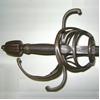
I'm getting goosebumps thinking of some "professional" sharpening an old weapon...  ... kind of raping.... ... kind of raping....Having two older beauties which were ground down to get a sharp point, my heart is breaking every time I see them  One is a "training weapon" for duels with a Klingenthal blade (around 1895), with the guard of o duelling weapon which used to have a flattened tip. Nevertheless a wonderful piece, but... not original any more... The sharping was done quite professional, I just found out when I checked the length of the weapon and compared it with other weapons. I've attached two pics. Coming back to the foil: perhaps the grooves on the grip were made to provide a grip for some kind of leather-wire binding  this would keep the wire in it's place. All the best William |
|
|
|
|
2nd December 2008, 09:15 AM
|
#5 |
|
Member
Join Date: Mar 2005
Location: Australia
Posts: 685
|
Hi William,
A very beautiful foil - Thanks for sharing. Cheers Chris |
|
|
|
|
2nd December 2008, 12:59 PM
|
#6 |
|
Member
Join Date: Nov 2008
Posts: 334
|
Beautiful indeed -
yet not a foil, but an epee, note the tri-blade. This is the main duelling weapon of the 19th century, along with the single shot pistol. The shallow hollow indicates an early blade (without a milled groove), the hilt combination suggests an age of 1860-1880's. I used to have a similar epee with a knight's head pommel but of iron rather brass, with a decorated steel dish guard, circa 1900. |
|
|
|
|
2nd December 2008, 11:01 PM
|
#7 |
|
Member
Join Date: Mar 2008
Posts: 33
|
Always a pleasure
As stated before: Someone tried to convert it into a "real" fencing weapon and seemed to have used some kind of cutter to sharpen the tip and part of the ricasso (nearly destroying the Klingenthal marking). @broadaxe Your dating is nearly correct. The bladesmith markings on the opposite side of the Klingenthal writing indicate 1895 as year of forging. Can you tell me since when the "milled groove" was used? I was quite sure that it was widely used after electric fencing was invented (for epee this was around 1936); because this made things easier for the forges to meet the requirements of this "new" sport. Although I own a blade most probably dating before that date. And may I ask how you draw the lines on your suggestion for the dating of the epee? Thanks in advance. William |
|
|
|
 |
| Thread Tools | Search this Thread |
| Display Modes | |
|
|


 Hybrid Mode
