
|
 18th December 2025, 12:10 PM
|
#1 |
|
Member
Join Date: Apr 2015
Posts: 168
|
 Halberd question
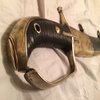
Hi, I picked this up yesterday. It was cheap, but you get what you pay for. I have serious doubts about this halberd. I have my doubts because where the point is attached to the blade(in the photo near my finger) is so oddly/roughly forged. The only thing I can think of is that it was reattached at some point. Is it a 19th-century copy or an original? It might be original, but has the handle ever been replaced? I have no idea.
Does anyone here know more about this? |

|

|
|
18th December 2025, 12:12 PM
|
#2 |
|
Member
Join Date: Apr 2015
Posts: 168
|
some more pictures
|
|
|
|
|
18th December 2025, 07:21 PM
|
#3 |
|
Member
Join Date: Apr 2017
Location: Sweden
Posts: 785
|
It’s roughly forged that’s for sure but these things sometimes were. At least it doesn’t seem to have been moulded which is a good sign. Sometimes halberds were roughly produced in large numbers and then stored in armouries in case of future invasions. This could be such an example. An earlier post in this forum showed a halberd with an armoury mark on the pole from Switzerland. Other promising signs of originals are sharp tips on the spike and sharpened axe blade. If the halberd was made for Victorian decoration it would probably not have been sharpened for business.
|
|
|
|
|
18th December 2025, 10:30 PM
|
#4 | |
|
Member
Join Date: Apr 2015
Posts: 168
|
Quote:
|
|
|
|
|
|
19th December 2025, 06:04 AM
|
#5 |
|
Member
Join Date: Dec 2004
Location: NC, U.S.A.
Posts: 2,229
|
While out of my wheelhouse, it certainly looks like it is older than Victorian. Could this perhaps be an American halberd from the Rev War period? There were plenty of crude spontoons, halberds and linstocks made by the Continentals under stressed situations. Take a look at Neumann's 'Swords & Blades of the American Revolution' for similar examples.
Mark |
|
|
|
|
19th December 2025, 03:54 PM
|
#6 |
|
Member

Join Date: Feb 2012
Location: Romania
Posts: 211
|
It is very likely a halberd from southern Germany from the 16th century.
It is possible that the handle was added more recently. It is very beautiful. 
|
|
|
|
|
20th December 2025, 01:26 PM
|
#7 |
|
Member
Join Date: Apr 2015
Posts: 168
|
Thank you all for your responses! I've found a very interesting article. The authors examined all the halberds in the Dutch Army Museum (131 examples) and classified them into types. Definitely worth reading for anyone interested in halberds. According to the article, the example I have is a subtype II.A-2.
https://www.tandfonline.com/doi/full...1728905#d1e141 |
|
|
|
|
20th December 2025, 04:26 PM
|
#8 |
|
Member
Join Date: Apr 2017
Location: Sweden
Posts: 785
|
Thank you for posting link to interesting article. Didn’t see it before. The Waldman and Snook publications are the classics for halberds. If you search previous posts in this forum you should find the one with the Swiss halberd with the armoury mark on the pole.
|
|
|
|
|
31st December 2025, 10:37 PM
|
#9 |
|
Member

Join Date: Apr 2014
Posts: 237
|
My opinion- The main body is original. The haft and langets are recent repairs. The central spike is also probably a recent repair. Not a bad piece, if the price was right.
|
|
|
|
 |
| Thread Tools | Search this Thread |
| Display Modes | |
|
|


 Linear Mode

