
|
|
|
 28th May 2024, 01:51 AM
|
#1 |
|
Vikingsword Staff

Join Date: Dec 2004
Location: The Aussie Bush
Posts: 4,681
|

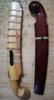
Rob, a horn hilt and an iron ferrule are common on Filipino agricultural tools. Both are inexpensive materials in the Philippines. Horn is only a little fancier than wood, but it is more durable than wood in the tropical heat and wet. The biggest threat to horn are insects, which have been chewing away at the hilt you show. Faceting of the hilt is also common on agricultural knives and bolos. It is a simple construct made with a draw knife and enhances the grip relative to a circular cross-section. It is actually easier to make a faceted hilt than a circular smooth one using traditional tools.
|

|

|
|
28th May 2024, 05:53 AM
|
#2 |
|
Member
Join Date: Feb 2014
Posts: 466
|
Is there any indication that the hilt might have been shortened, due to having been damaged? It seems rather awkward/unbalanced in that dimension.
I could see it as a kitchen implement, myself. |
|
|
|
|
28th May 2024, 06:47 AM
|
#3 |
|
Vikingsword Staff
Join Date: Dec 2004
Location: The Aussie Bush
Posts: 4,681
|
Bob, given that the blade is 9 in. long, it appears that the hilt is about 4.0 to 4.5 in. in length. That's plenty long enough for most Filipino hands. There is also an option to move the hand forward and place the thumb and forefinger on the blade for more precise work. There is actually a small curved area where the end of the blade meets the ferrule where a finger could rest comfortably when using a pincer grip.
|
|
|
|
|
28th May 2024, 12:32 PM
|
#4 |
|
Member
Join Date: Apr 2011
Posts: 66
|
In Java, there are variations on the shape of knife that is intended to slice tobacco. I do have several at home, one of it has the awkward handle shape just like this knife (family heirloom, it was belong to my late grandpa). But one of it treated as kind of "pusaka", it had warang in the past, and has handle just like a golok handle.
|
|
|
|
 |
| Thread Tools | Search this Thread |
| Display Modes | |
|
|


 Hybrid Mode
