
|
 16th May 2016, 03:48 PM
|
#1 |
|
Member
Join Date: Dec 2004
Location: Ann Arbor, MI
Posts: 5,503
|
 Indian pseudoshashka
We are all familiar with the so-called Afghani pseudoshashkas ( as per Lebedinsky): Afghani blade, stamp of Mazar-i-Sharif mosque, no guard, pommel with elongated ears.
Here is an unusual variant that just ended on e-bay. Indian blade ( even with Indian ricasso), no stamps, steel fittings a la tunkou, D-guard, round and solid pommel. In short, as many differences as one can imagine. My guess it is from the India/Afghan border area, exhibiting a curious amalgam of both traditions. Likely a tribal manufacture. It looks even older than the usual Afghani ones, although who knows.. |

|

|
|
16th May 2016, 04:58 PM
|
#2 |
|
Member
Join Date: Jun 2013
Posts: 2,145
|
Hi Ariel,
I think it's a crapmix of everything, it's also a pseudo yatagan, look at the Turkish ricasso added to hide the combinaison of different elements... Best, |
|
|
|
|
16th May 2016, 06:20 PM
|
#3 |
|
Member
Join Date: Dec 2004
Location: Ann Arbor, MI
Posts: 5,503
|
If you think it is a recent work, I disagree: all parts look genuine , old and worn. Yes, there are signs of recent repair ( glue under the cheeks), but my guess the wood has shrunk. The D-guard is integral to the bolster:
If you think it is a crazy old mixture of styles, we are on the same page. And I would not call it Turkish ricasso: similar motive is seen on old Persian examples, just as a quick example. |
|
|
|
|
19th May 2016, 12:44 PM
|
#4 |
|
Member

Join Date: Jul 2006
Location: Buraimi Oman, on the border with the UAE
Posts: 4,408
|
In my view this is genuine. I would be surprised if this was a one off morphed example but moreover a style of sword earlier than expected... an earlier variant of Shaska . Ariel over to you on the possibilities but I am looking for suitable swords to compare it with... Showing below the treatment given to Yatagan throats of blades... I begin to think this form was an earlier style of Shashka?...

Last edited by Ibrahiim al Balooshi; 19th May 2016 at 01:15 PM. |
|
|
|
|
19th May 2016, 06:32 PM
|
#5 |
|
Arms Historian

Join Date: Dec 2004
Location: Route 66
Posts: 10,863
|
Ibrahiim, nicely done finding that example and noting the comparative prospects with yataghan gestalt. It is truly a weapon worth discussing and evaluating further rather than dismissing it as some sort of hodgepodge. I know I have seen something similar but have yet to find it, and it seems there are is a group of sabre types which look as if they are typical sabre hilts sans their guards.
I am with Ariel in his assessments on this being a genuinely fabricated older (certainly 19th c) weapon. These kinds of hybrids have always had some degree of presence in ethnographic weapons, as innovative armorers often used whatever materials and components they had at hand. The use of 'pseudo' in terming these weapons or for that matter any weapon form is not really in my opinion acceptable, as it implies direct connection between forms which may not have any direct or linear connection. For example, in the case of the Bukharen sabres without guard, according to well informed authorities are not at all developed from shashkas, which has sometimes been suggested. This carries into the Afghan/Uzbek case as well though obviously there must be some degree of influence present. I think that Russian presence in these Central Asian regions certainly must have had certain impacts, if only temporal, and of course in the latter part of the century, Caucasian shashkas were known in Russian forces. What is interesting in this example is the clearly fashioned tunkou, which compellingly recalls yataghan or Ottoman influence also very much present in degree. The ricasso recalls Indian blade forms coupled with the sweeping radius of the shamshir Interesting weapon, and perfect for sword forum discussion!!! |
|
|
|
|
20th May 2016, 02:48 AM
|
#6 |
|
Member
Join Date: Dec 2004
Location: Ann Arbor, MI
Posts: 5,503
|
Ibrahiim,
Here is my version of your request: IMHO, Bukharan ( not Afghani, as per Lebedinsky!) pseudoshashkas ( sorry for a totally inappropriate term, but for want of a better one...) derive their origin not from the shashkas of Russian invaders and subsequent occupants, but from Khybers or their earlier analogs. Here is the series of graded modifications: classical Khyber at the top, early Bukharan " shashka" in the middle ( straight blade, almost triangular geometry) and classical Bukharan "shashka" ( slightly curved blade, almost "hatchet" point). The last two swords are attributed to Bukhara ( more precisely Central Asia) partly by the characteristic feature of 5 rivets ( 2x1X2). Jim, In a little while a paper one of my Russian colleagues and I have written together will appear in a major arms history journal. It will be dealing with the origin of yataghan blades and a large part of it will be referring to tunkou, the heretofore forgotten or neglected element of Ottoman yataghans. Just in brief, it is not an inherently Ottoman, but a Turkic element, tracing back to nomads, Seljuks and Mongols included. This is why we see it or its renditions on some Persian and Indo-Persian blades and even in some very early European iconographic sources. And I completely agree with Ibrahiim's point: the eared pommel of Caucasian shashka likely stems from the same element of the Ottoman yataghans. Last edited by ariel; 20th May 2016 at 11:57 AM. |
|
|
|
|
11th July 2016, 04:51 PM
|
#7 |
|
Member
Join Date: Dec 2004
Location: Ann Arbor, MI
Posts: 5,503
|
For those who assumed that this bizarre hodge-podge of different styles was a unique example, here is another one, just ended on Dan Morphy's auction.
We seem to be talking about a rare pattern. |
|
|
|
|
13th July 2016, 01:31 AM
|
#8 | |
|
Member
Join Date: Jul 2006
Location: Buraimi Oman, on the border with the UAE
Posts: 4,408
|
Quote:
Keep it coming Ariel ... This is an amazing thread.
|
|
|
|
|
|
13th July 2016, 02:56 AM
|
#9 |
|
Member
Join Date: Dec 2004
Location: Ann Arbor, MI
Posts: 5,503
|
How funny: the same pattern is discussed here
http://www.vikingsword.com/vb/showth...d=1#post203006 Perhaps, merging the threads might be in order? |
|
|
|
|
13th July 2016, 08:26 AM
|
#10 | |
|
Member
Join Date: Jul 2006
Location: Buraimi Oman, on the border with the UAE
Posts: 4,408
|
Quote:
I agree Ariel... These are surely the same form....or am I losing the plot?? |
|
|
|
|
|
15th July 2016, 02:22 AM
|
#11 |
|
Member
Join Date: Apr 2005
Posts: 3,255
|

Hello Ariel,
Thanks for bringing these up! Did you won the first example? I agree that the hilt of both sabres seem to be of the same type and possibly related to the hilt type in the other thread. A probable third example got posted there and I'm attaching it below for reference (with the brass fittings and apparently different workmanship it may be more recent). Do the blades and the single scabbard allow any attribution? Any feature that doesn't fit with a Deccani origin? All hilts are fastened with 3 rivets and seem to be of full tang construction. It is interesting that the first example seems to represent a bird's head while the third is much more abstract and the second one seems to approach the more bulbous pommel style. The langet-like feature seems to be separate from the bolster+guard in the first example. I'm not sure that merging both threads is going to help our ongoing discussion; especially, since we haven't yet established that these really share the same origin. The cross-referencing should do for directing attention to the possibly related threads, I guess. Regards, Kai |
|
|
|
|
15th July 2016, 02:47 AM
|
#12 |
|
Member
Join Date: Apr 2005
Posts: 3,255
|

Hello Ariel,
The inversed-tunkou(-like) feature of yataghans as well as the tunkou of East Asian blades will both originate from the langet-like construction utilised to secure South Indian blades. In the swords discussed here and in the companion thread, this feature is very similar to yataghan, indeed. If this isn't a surviving older Indian or central Asian element and really a Turk influence, would the time line make an Ottoman-Deccani or a Turk-"Afghan" cultural transfer more likely? Regards, Kai |
|
|
|
|
15th July 2016, 11:45 PM
|
#13 |
|
Member
Join Date: Dec 2004
Location: Ann Arbor, MI
Posts: 5,503
|
I have already expressed my opinion on that on the "other" thread.
Again, IMHO, the "tunkou" has nothing to do with the S.Indian technique of attaching the blade to the handle. Was the "tunkou" brought by the ancient nomads through their successors ( Babur in India, for example, Seljuks in Iran and Turkey) or later on by the Ottoman influences, I do not know for now, and this is an immensely important question. |
|
|
|
|
16th July 2016, 08:57 AM
|
#14 | |
|
Member
Join Date: Jul 2006
Location: Buraimi Oman, on the border with the UAE
Posts: 4,408
|
Quote:
In the case of this sword which I think could be a hybrid or even formed of different regional weapons and possibly a European blade we know very little of its origins but influence seems to be broad based including Pesh Kabz, Kard, Patta, and several others regarding throat decoration and from a lot of weapons with the peculiar hand guard including even Sri Lankan Kastane.... It may be nothing to do with the Yatagan or Shashka. It is for this reason...in wanting to focus on its origin that I have asked for a joining of the threads...so that the full weight of Forum can be brought to bare on this problem. |
|
|
|
|
|
17th July 2016, 12:52 PM
|
#15 |
|
Member
Join Date: Jul 2006
Location: Buraimi Oman, on the border with the UAE
Posts: 4,408
|
I find a small reference to the Chinese potential nature of such weapons... Quote "
Kouming Dao * Ho & Bronson 2004 p111 "... the [Qianlong] emperor appears to have been quite fond of non-traditional curved sabers of the Indian and Middle Eastern type, often furnished with jade hilts carved in the Indian Mughal style. Some were imitations made in the imperial armory in Beijing." * Ho & Bronson 2004 p114 f127 "Qianlong ordered a total of sixty ceremonial curved swords on five occasions, in 1748, 1757, 1779, 1793, and 1795. Each sword was named and numbered, and all were identical in length, weight, and basic design. The scabbards were made either of red or green stingray skin and or patterned bark. The swords differed in terms of their inlaid details and the style of the hilts. Hilts made after completion of the 1757 batch were mostly in Mughal style, often with gold and inlaid gems."Unquote. I can find not much in the way of pictures but I saw a good parrot or bird head pommel dagger in the Mughal style and place here below for reference...Regarding the Chinese connection it is interesting that a sister Chinese sword has the bolstering at the throat but reversed...more on that later... I think it wise enough ...to consider the bolstered throat rather than just the decorative often koftgari technique in comparing the weapon and that this is where the direction of research seems to point...even though the decorative similarities may be compelling. I place some decorative reference and some knuckle guard comparison etc below...in addition. In adding the peculiar s bend blade inh an Indian style of ceremonial sword I do so to illustrate bolstering and note that many Indian weapons have something similar in their design. I say this to caution against too much emphasis on comparison to the Yatagan...although they may be related ...so may be many others. Last edited by Ibrahiim al Balooshi; 17th July 2016 at 01:28 PM. |
|
|
|
|
17th July 2016, 01:40 PM
|
#16 |
|
Member
Join Date: Jul 2006
Location: Buraimi Oman, on the border with the UAE
Posts: 4,408
|
Blade. In comparing blades ...and again the Yatagan springs to mind however, the Sosun Pata is Indias take on blades of that shape https://indiansforguns.com/viewtopic...=20125#p193554 refers to blade shape and the general high class nature of the weapon in question ...possibly as a court sword...etc
With an eye on the Chinese potential Pei Dao illustrate how the bolstering at the the throat or Tunkou is actually the reverse format of the Indian type...Shown below with the red hilt. The Kouming Du however is known to have been influenced by Moghul form...many having been exported to India ...Shown below with the white Hilt and greenish scabbard. Below top... are 3 swords; The top one of which may fall into the Sosun Pata blade category which was taken from Yatagan style..but is Indian. Given a high class jade or crystal hilt (for VIP/court sword use) I suggest that this is the same family ... Are we therefor looking at an amalgam of Chinese/Indian style perhaps further complicated in some having European blades added later? Last edited by Ibrahiim al Balooshi; 17th July 2016 at 02:50 PM. |
|
|
|
|
18th July 2016, 12:01 PM
|
#17 |
|
Member
Join Date: Jul 2006
Location: Buraimi Oman, on the border with the UAE
Posts: 4,408
|
PLEASE NOTE http://thomaschen.freewebspace.com/custom3.html where much of the groundbreaking research was carried out by Mr Philip Tom. The article notes a fashion in Chinese swords and close ties with sword influence going both ways. Swords made in Beijing were exported to India after 1761 . Further ..a common description amongst Chinese sword design was the pistol grip which is essentially the same as the bird head or parrot head hilt. Note also the practice of cutting grooves in the blade and inserting pearls which roll up and down the grooves; This is a direct copy from Indian blades of that form.
Shown in addition below is the trend in Indian blades; both sword and dagger, of decorating the throat with a cartouche done in Koftgari form but that in the project sword this is of Tunkou style essentially a reinforcement plate giving support to the hilt and enabling a tighter fit for the blade into the scabbard....something koftgari design does not do...nor was it designed to. Given that in the late 1700s Chinese swords were exported to India it stands to reason that the Tunkou was in fact part of this design imported on these weapons but turned the other way...perhaps to satisfy Indian taste from purely an aesthetic viewpoint as it looked better? See thye Chinese form below. Regarding the pistol grip hilt which was a Chinese ingredient it is commonly seen in Indian hiltsb although the6y a4re no slouch when it comes to Zoomorphic hilts...The Indian parrot hilt may by now be a mixed and morphed design though birdhead hilts may go back further in Indian style and it ma6y be simply co incidental. Non the less Chinese pistol grip hilts were common during the period and as a note to the margin of this interesting design. Last edited by Ibrahiim al Balooshi; 18th July 2016 at 12:30 PM. |
|
|
|
|
19th July 2016, 03:33 AM
|
#18 |
|
Member
Join Date: Jul 2006
Location: Buraimi Oman, on the border with the UAE
Posts: 4,408
|
It occurred to me to consider the Turkic influence and to address the very pertinent questions earlier in this thread as to the major design fashion/highlight of the project sword at the throat illustrating how India absorbed both the Koftgari and Tunkou aspects but more importantly where its own source of such style is present. Bolstered blades are common to Indian style as are koftgari decorations at the throat. Chinese weapons were quite late in the 17th C...and of a reversed Tunkou style not common in Indian swords. The time scale of Turkic cross pollination of style seems to better fit the picture moreover Hindu and Buddhist decorative style seems to indicate a far earlier transition in Indian sword decoration. See the Tibetan form below. Common to Indian, Ottoman and Chinese hilt style are the birdheads or Parrot form hilts...Zoomorphic hilts developed as a consequence of artistic and cultural style thus pistol grip design cannot be attributed specific to either except that the timeline would indicate favouring the Ottoman influence going back to Turkic influence. The knuckle guard can be seen across India and neighboring regions including the Sri Lankan Kastane but also in mainline weapons such as Tulvar etc...On blade style it is noted that Indian Sosun Pata form derived from the Ottoman Yatagan.
Thus having compared the weapon at 1 and its derivatives I conclude that this weapon probably originated in Turkic fashion spreading through Ottoman style into Indian via the influence of the Yatagan as well as additions from Indian home grown design. Although interesting the Chinese influence appears too late in proceedings and has the added hurdle of a Tunkou reversed in design placement on Chinese swords... To compare the way influence flowed from India to China and vice versa...see Thomas chens detail at http://thomaschen.freewebspace.com/photo2.html where he notes Quote" Chinese and Islamic sabers, owing to both having a common ancestor (the Turko-Mongol saber), and also due to mutual cross-pollination and interaction, have several common features" Unquote. Last edited by Ibrahiim al Balooshi; 19th July 2016 at 04:34 AM. |
|
|
|
|
20th July 2016, 03:14 AM
|
#19 |
|
Member
Join Date: Jul 2006
Location: Buraimi Oman, on the border with the UAE
Posts: 4,408
|
Having said all that... I am acutely aware of similar form and style seeping into Afghanistan sword form...and have prepared a picture to support that below. Meanwhile your comments are invited on the discussion so far...
Last edited by Ibrahiim al Balooshi; 20th July 2016 at 03:24 AM. |
|
|
|
|
20th July 2016, 04:09 AM
|
#20 |
|
Member
Join Date: Jul 2006
Location: Buraimi Oman, on the border with the UAE
Posts: 4,408
|
Forum Library Reference.
In a separate development I also note for readers the following thread http://www.vikingsword.com/vb/showthread.php?t=2411 which is from 2006 and examines Chirkas which is another close form ..
|
|
|
|
|
20th July 2016, 12:08 PM
|
#21 |
|
Member
Join Date: Jul 2006
Location: Buraimi Oman, on the border with the UAE
Posts: 4,408
|
In coming to an almost full circle..I observe the style of sword in Shashka form sweeping in from the periphery of India, Turkey, Afghanistan, China Persia...and from far flung Russian form, Uzbekistan, and the Caucasus et al....
As a general comment I feel the entire blend of this style shrouded in the mists of time and though similarities abound no one form seems to have its nose in front... It appears that over the hundreds of years of flow, influence and design both from North Asian sectors and Chinese derivatives and in fact from all points of the compass with India at the centre that no one area can claim this weapon absolutely...We cannot rule out the early design flow of Turko/ Mongol style and the obvious tribal tectonic plate movement into Anatolia etc...The ear pommel Yatagan designs seem compelling with bolstered throats and where crossover copying is difficult to rule out. The Shashka form; Below I have poured the entire shashka selection or close relatives into the same pot. My thought is that whilst there may be a common thread tying them all that in many cases this is virtually impossible to absolutely confirm but that as a general rule these weapons are similar though on the periphery and of the Shashka type. More research is needed on the knuckle guard and pistol grip hilt although it is known that Shah Jehan designed his own Jade and Neophrite versions around the bird head theme on both swords and daggers. Meanwhile your comments are requested.. Last edited by Ibrahiim al Balooshi; 20th July 2016 at 12:43 PM. |
|
|
|
|
21st July 2016, 12:28 AM
|
#22 |
|
Arms Historian
Join Date: Dec 2004
Location: Route 66
Posts: 10,863
|
I have to say these are wonderful panoplies of this spectrum of amazing and exotic sword examples!
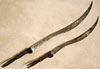
In reading through these discussions, I think it is important to remember that the word 'shashka' is simply a Russian word for sword, not otherwise specified, much in the way that the words tulwar in India; kilij in Turkey; and sa'if in Arabic are. While these terms have become associated with specific forms in the glossaries of collectors, their use can often create semantics issues in narratives and discussions. I would note here that while the feature known as tunkou, or the collar or sleeve at blade root of many edged weapons in Turkey, China and Central Asia is interesting as a key feature reflecting distinct influences between cultures, it is subordinate to trying to find connections with these curious sabres with knuckle guard and no other supporting cross guard. As far as I have known, the 'tunkou' seems to have evolved in Altaic regions with nomadic steppes tribes sometime in the span of 6th-12th centuries. It seems most known exemplars are from 9th-10th ("Arms of the Yenesai Khirghiz 6-12th C", Y.S.Khudyakov, 1980, as cited in "The Mongol Warlords", David Nicolle, 1988). In these cases these sleeves or collars were placed on the blade edge near the hilt, and according to Nicolle as others, typically are regarded as to offer more secure fit in scabbard. In other respects, it is thought to function as a sort of Indian ricasso to protect finger if over guard or perhaps drawing sword from scabbard. It is interesting that this feature took a different placement with the Turkish application, being on the back of the blade and diagonally across seemingly as a seating for the crossguard and again to secure the hilt in scabbard. On the Chinese examples by the 17th century, this feature again is seen. Later it would seem that the feature became vestigially represented in koftgari on various weapons. In "Arms and Armour of the Crusading Era 1050-1350" , David Nicolle, 1988, in example 37 A-D it is noted that asymmetrical guards occur on both edge and back of blade in swords of 9th-13th c. in regions of Kursk and Kiev in Ukraine. It is mentioned that such guards are seen in art of Afghan and Indian regions in depictions of arms. It would seem that the influences of the arms of these various cultures and ethnic groups are profoundly confluenced over many centuries which would make specific or definitive assertions connecting these difficult at best. With the curious examples of this thread with pistol grip, knuckle guard with recurved terminal at pommel and tunkou, it does seem they comprise a certain group of similar form. It seems there have been sabres of either shamshir or other sabre forms with the guard notably absent in Ottoman and sometimes it seems East European or 'Cossack' context, I believe Zaparozhian. Given these possibilities, it seems to lend more compelling look toward Afghanistan and India's northern regions, further owing to the Central Asian and Russian denominators mentioned. The recurve on the knuckle guard terminals of many northern Indian swords is often regarded as having been from Ottoman influence, just as the quillon terminals on many tulwars. The pistol grip form seems Ottoman as well. To consider the open form of the shashka hilt, the Ottoman recurve on the guard and the Turkic tunkou of Central Asia to me seems a compelling confluence of features suggesting North India and Afghan regions for these sabres. The images are an excavated sabre blade believed 9th century from Nishapur regions and the other an Altaic (S. Siberia) sabre of 10thc. |
|
|
|
|
21st July 2016, 01:33 AM
|
#23 |
|
Member
Join Date: Dec 2004
Location: Ann Arbor, MI
Posts: 5,503
|
Ibrahiim,
With all due respect it seems to me that you are "lumping" different and unrelated weapons into one happy family. This may be a necessary and inavoidable step at the beginning of any scientific inquiry, but it should be followed by a more advanced stage, I.e. "splitting". Regretfully, we do not have actual examples of Caucasian shashkas dating to before the very beginning of 19th century. Iconographically, there are portraits of Cossack chieftains dating to the 18th century with fully developed Circassian shashkas ( to the point of that there are Russian "patriots" claiming that shashka was an originally Cossack weapon, an that Caucasians just stole the idea from them). Similarly, I am unaware of any "Bukharan" examples before the 19th century. This is not dissimilar to our ignorance of Turkish weapons prior to Mehmet II. In that part of the world weapons were actually used non-stop, the idea of museum conservation was unheard of and nobody cared enough to leave a detailed treatise with illustrations and historical analysis. Thus, the genealogy of shashka-like sabers can only be observed "... Through a glass darkly"..... |
|
|
|
|
21st July 2016, 02:51 AM
|
#24 |
|
Arms Historian
Join Date: Dec 2004
Location: Route 66
Posts: 10,863
|
I have long very much admired the scholars among us who have had the tenacity and endurance to deeply study the complex histories of Central Asia, the Caucusus and the Steppes into China. Even those descriptive areas cannot possibly approach the incredible anthropological and cultural elements comprehensively.
I agree with Ibrahiim in observing the futility of trying to find distinct connection between this number of weapons having certain degree of similarity and often subtle influences and from such broad sources ethnically as well as geographically over long periods of time. The genealogy analogy is well placed, as I personally discovered in the years I tried to accomplish my own. While often dead ends and misperceptions plagued the search, it helped to place all possibilities together in order to comprehensively keep them in perspective. While the tunkou element is a subject unto itself, and I brought what I could discover in my earlier post......the subject of these swords as a form remains quite clouded. By collectively putting our research and ideas together however, who knows what me might discover!!! |
|
|
|
|
21st July 2016, 02:30 PM
|
#25 | |
|
Member
Join Date: Jul 2006
Location: Buraimi Oman, on the border with the UAE
Posts: 4,408
|
Quote:
Salaams Ariel, Thank you for your post in which you describe the situation of my posts as being .."Through a glass darkly"... which I am sure you will agree is a far better state than "looking through mud" at a subject long ignored. I am glad you noted my lumping all the possibilities together which is exactly what my aim was ..and since we are at the beginning (almost) on this quite peculiar form I did indeed deliberately group as many of the variants together and it can be seen what is potentially link-able and more importantly what is not. It also serves I hope, to illustrate to other readers how diverse this form may be...and in grouping together form from different points of the compass it may be seen what a vast subject this is... |
|
|
|
|
|
21st July 2016, 03:01 PM
|
#26 |
|
Member
Join Date: Jul 2006
Location: Buraimi Oman, on the border with the UAE
Posts: 4,408
|
[QUOTE=Jim McDougall]I have to say these are wonderful panoplies of this spectrum of amazing and exotic sword examples!
In reading through these discussions, I think it is important to remember that the word 'shashka' is simply a Russian word for sword, not otherwise specified, much in the way that the words tulwar in India; kilij in Turkey; and sa'if in Arabic are. While these terms have become associated with specific forms in the glossaries of collectors, their use can often create semantics issues in narratives and discussions. I would note here that while the feature known as tunkou, or the collar or sleeve at blade root of many edged weapons in Turkey, China and Central Asia is interesting as a key feature reflecting distinct influences between cultures, it is subordinate to trying to find connections with these curious sabres with knuckle guard and no other supporting cross guard. As far as I have known, the 'tunkou' seems to have evolved in Altaic regions with nomadic steppes tribes sometime in the span of 6th-12th centuries. It seems most known exemplars are from 9th-10th ("Arms of the Yenesai Khirghiz 6-12th C", Y.S.Khudyakov, 1980, as cited in "The Mongol Warlords", David Nicolle, 1988). In these cases these sleeves or collars were placed on the blade edge near the hilt, and according to Nicolle as others, typically are regarded as to offer more secure fit in scabbard. In other respects, it is thought to function as a sort of Indian ricasso to protect finger if over guard or perhaps drawing sword from scabbard. It is interesting that this feature took a different placement with the Turkish application, being on the back of the blade and diagonally across seemingly as a seating for the crossguard and again to secure the hilt in scabbard. On the Chinese examples by the 17th century, this feature again is seen. Later it would seem that the feature became vestigially represented in koftgari on various weapons. In "Arms and Armour of the Crusading Era 1050-1350" , David Nicolle, 1988, in example 37 A-D it is noted that asymmetrical guards occur on both edge and back of blade in swords of 9th-13th c. in regions of Kursk and Kiev in Ukraine. It is mentioned that such guards are seen in art of Afghan and Indian regions in depictions of arms. It would seem that the influences of the arms of these various cultures and ethnic groups are profoundly confluenced over many centuries which would make specific or definitive assertions connecting these difficult at best. With the curious examples of this thread with pistol grip, knuckle guard with recurved terminal at pommel and tunkou, it does seem they comprise a certain group of similar form. It seems there have been sabres of either shamshir or other sabre forms with the guard notably absent in Ottoman and sometimes it seems East European or 'Cossack' context, I believe Zaparozhian. Given these possibilities, it seems to lend more compelling look toward Afghanistan and India's northern regions, further owing to the Central Asian and Russian denominators mentioned. The recurve on the knuckle guard terminals of many northern Indian swords is often regarded as having been from Ottoman influence, just as the quillon terminals on many tulwars. The pistol grip form seems Ottoman as well. To consider the open form of the shashka hilt, the Ottoman recurve on the guard and the Turkic tunkou of Central Asia to me seems a compelling confluence of features suggesting North India and Afghan regions for these sabres. The images are an excavated sabre blade believed 9th century from Nishapur regions and the other an Altaic (S. Siberia) sabre of 10thc.[/QUOTE Thank you very much Jim and your explanation of Tunkou is appreciated. I see a different way of engineering the knuckle guard in both examples below perhaps indicative of different regional methods of engineering the hilt/guard/Tunkou. I thought when observing the references that it would be a good idea to have the Tunkou on the cutting edge "Chinese style" rather than the back blade since mounted it would act as a more secure fit and the safety factor of drawing swords at the gallop with a protective Tunkou would indeed save cut fingers (see red hilt Chinese sword below). Having the Tunkou on the cutting edge is probably the reason it is reversed so that more blade is covered.. I must say the knuckle guard is indeed difficult to source...as so many Indian weapons have it whilst other weapons in the same family do not...Tulvar springs to mind...I also assumed therefor that attaching a knuckle guard would be relatively easy though I puzzled at the lack of Shashka with knuckle guards ... It seemed to me that we were looking at just that... A shashka form with knuckle guard and Tunkou. |
|
|
|
|
23rd July 2016, 04:10 PM
|
#27 |
|
Member
Join Date: Jul 2006
Location: Buraimi Oman, on the border with the UAE
Posts: 4,408
|
Salaams all...I wonder what Forum makes of this? ...Said to be from Afghanistan...? Are we looking at Turko/Mongolian mounted cavalry aspects... with the Tunkou and Knuckle Guard...?
Regards, Ibrahiim al Balooshi. |
|
|
|
|
23rd July 2016, 04:34 PM
|
#28 |
|
Member
Join Date: Jul 2006
Location: Buraimi Oman, on the border with the UAE
Posts: 4,408
|
It would seem logical in considering the bolstered throat arrangement that hurtling along at great speed on horseback some danger to the rider would be encountered on drawing or placing the sword back in the scabbard...to the hand and fingers. It may be why the design of the Tunkou appears on daggers...in Koftgari only (not the full Tunkou form)
 since the Warrior would almost never draw a dagger on horseback ... but would certainly draw the sword pictured above. Actually when imagining the draw; it is the thumb which assists the backblade out of the scabbard and of course the hand. since the Warrior would almost never draw a dagger on horseback ... but would certainly draw the sword pictured above. Actually when imagining the draw; it is the thumb which assists the backblade out of the scabbard and of course the hand.Secondly and I favour this;...the sword would fit much more tightly in the scabbard with this bolstering ...Thus the Tunkou as noted earlier has a dual purpose. |
|
|
|
|
24th July 2016, 04:18 AM
|
#29 | |
|
Member
Join Date: Apr 2005
Posts: 3,255
|
Hello Ibrahiim,
Thanks, that's a good find! Link? Quote:
Regards, Kai |
|
|
|
|
|
24th July 2016, 04:29 AM
|
#30 | ||
|
Member
Join Date: Apr 2005
Posts: 3,255
|
Hello Ibrahiim,
Quote:
Short of very unfavourable circumstances, one would expect the blade to be cleaned before it being returned into the scabbard... Quote:
Regards, Kai |
||
|
|
|
 |
| Thread Tools | Search this Thread |
| Display Modes | |
|
|


 Linear Mode

