
|
 27th March 2026, 03:30 PM
|
#1 |
|
Member
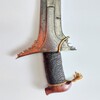
Join Date: Oct 2018
Posts: 714
|
 Hopping back with a garab
I've taken a break from sword collecting for quite a while, but recently hopped back by acquiring this garab. 19in blade, 5.5in hilt, 1.2cm spine, hefty feel. At first glance, I would posit it as conservatively late 1800s to early 1900s. A closer look reveals several things:
1. It has been repaired. There's a sliding panel-repair at the back, and the blade tang is pinned through the wooden hilt. My theory is that a stress crack occurred at that location. The artisan decided to remedy the crack by carving out a panel-section at the affected area, then reinforcing the blade with a pin at the same time. 2. The rattan wrap is minimal. There are telltale marks on the wood that it's only had 2 rattan bands ever since; the rest of the grip seems to be bare right from the start. I've seen at least one sample on the Krieger plates with a similar configuration- and I've held 2 other garabs with only rattan bands as opposed to full rattan wrap. 3. The scabbard rope stopper is an old Spanish coin. From what remains of the back part, it seems to be a Queen Isabella II, 8 Maravedis Spanish coin (1836-1858 production). It makes me suspect that this garab build could have existed even before late 1800s. The flip side, of course, was that it could have been placed by an owner who simply collected and affixed coins older than his current era (late 1800 perhaps). 4. A mini-rattan band longitudinal retrofit can be seen at the edge side of the scabbard; this helps keeps the scabbard closed and prevents the edge from peeking out. 5. There is a small, circular MOP affixed on the scabbard rope-holder area. 6. I'm guessing, based on taking apart similarly-featured blades before, that it has a laminated construction; but I prefer it to be cleanly polished for now. Let me know what you think...TIA! 
|

|

|
|
27th March 2026, 09:17 PM
|
#2 |
|
EAAF Staff
Join Date: Dec 2004
Location: Louisville, KY
Posts: 7,407
|
Nice true example. I agree with everything you have assessed. The carving one the hilt and the style of carving on the scabbard tell me that this is indeed an older garab.
The only thing I would add is that I wonder if the hilt had more rattan bands on it. I would also wonder if the coin is silver and this is a way of showing wealth, or, perhaps more likely, a talisman. |
|
|
|
|
27th March 2026, 11:44 PM
|
#3 |
|
Member
Join Date: Aug 2007
Location: Germany, Dortmund
Posts: 9,788
|
Hi Raymundo,
Very nice example! And the repair adds character. But like Jose I think that there was once more rattan bindings or another rattan binding. Anyway, a great addition to your collection. Regards, Detlef |
|
|
|
|
28th March 2026, 03:59 AM
|
#4 |
|
Member

Join Date: Mar 2005
Posts: 648
|
A Puzzle
xasterix,
I have a couple of Moro kris with that floating panel feature. I think it sits slightly proud of the surrounding hilt and is designed to grip the tang more tightly when the rattan banding or cord wrap is added. As your garab shows, the technique was used in both north and south. Were it not for the lack of a ghost of any additional wrap on the hilt, I would agree with Battara and Sajen that the hilt was originally bound up to the end of the rebate. On the kris examples I have, the floating panel was completely covered with cord wrap. A full wrap would certainly be more advantageous mechanically than to have just one end bound. I also wonder whether someone in the culture would have been willing to have a hilt pin showing so visibly. But, as your photos show, there is no ghost of additional hilt wrap. Sincerely, RobT |
|
|
|
|
28th March 2026, 09:31 AM
|
#5 | |
|
Member
Join Date: Oct 2018
Posts: 714
|
Quote:
The 8 Maravedis was a low-denomination coin, about 1/8th in value of a Spanish Real. It's a "commoner" coin (highly accessible to Indios) and made up of mostly copper, used to purchase common goods in the market and pay laborer's wages. The coin was even used for the "Cara Y Cruz" commoner's betting game (the winner correctly guesses if a coin toss is heads or tails). Because of its low value and lack of silver, I'm inclined to believe that it wasn't used as a status/nobility marker nor a talisman- but simply as a scabbard rope stopper. Its low value made it expendable enough to be used for such a practical purpose. This also leads me to believe- since the nobility and talismanic purpose is unlikely- that the coin has good potential to be an age indicator, in the same way that I could simply grab a modern-era Philippine peso (very common, low value, expendable) to be pierced and used as a scabbard rope-stopper for a modern-made blade. Other nobility swords (Moro, Ilonggo, etc) would prioritize putting high-value silver coins from current or older eras- making those coins unreliable for age approximation. |
|
|
|
|
|
28th March 2026, 09:34 AM
|
#6 | |
|
Member
Join Date: Oct 2018
Posts: 714
|
Quote:

|
|
|
|
|
|
28th March 2026, 09:39 AM
|
#7 | |
|
Member
Join Date: Oct 2018
Posts: 714
|
Quote:
|
|
|
|
|
|
28th March 2026, 03:28 PM
|
#8 |
|
Member
Join Date: May 2023
Location: San Antonio
Posts: 153
|
Nice garab!
Hi Xas,
Just out of curiosity, is the hilt meant to resemble a water buffalo, or is that just coincidental? |
|
|
|
|
28th March 2026, 07:15 PM
|
#9 | |
|
Member
Join Date: Oct 2018
Posts: 714
|
Quote:
|
|
|
|
|
|
28th March 2026, 07:22 PM
|
#10 |
|
EAAF Staff
Join Date: Dec 2004
Location: Louisville, KY
Posts: 7,407
|
I think it is more in the form of a plant.
|
|
|
|
|
29th March 2026, 04:29 AM
|
#11 | |
|
Member
Join Date: Oct 2018
Posts: 714
|
Quote:
|
|
|
|
|
 |
| Thread Tools | Search this Thread |
| Display Modes | |
|
|


 Linear Mode

