
|
 12th December 2025, 08:50 PM
|
#1 |
|
Member

Join Date: Dec 2023
Location: City by the Black Sea
Posts: 312
|
 Mafa Dagger
I've added a new piece to my African collection.
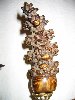
I believe it's from Northern Cameroon. Mafa / Matakam / Mafahay / Mofa / Natakan The Mafa also called Mafahay, is an ethnic group localized in northern Cameroon, Northern Nigeria and also scattered in other countries like Mali, Chad, Sudan, Burkina Faso and Sierra Leone. The Mafa occupy the centre of the Nothern Mandaras, consisting of the whole of the northern parts of the plateau of Mokolo and the mountain ranges north of Mokolo, leading down to the plain of Koza and reaching as far as the Moskota hills northwest of Koza. This example clearly shows the influence of various tribes. Handle shape – (sbula) Berber, Beja/Hadendoa, Morocco, Tunisia. Pommel – Tubu/Daza. Blade – Hausa, Kirdi (Cameroon). Sheath – Tuareg, Kirdi, Hausa. Sheath tip – Kirdi (Cameroon). Leather decorations – Mandingo. The connecting link is undoubtedly the Tuareg, who controlled the trans-Saharan trade for several centuries, and the Tubu/Daza, who led the caravans across the Sahara. Overall length in sheath: 460 mm, blade length: 315 mm, width: 35 mm, thickness: 4 mm, weight: 223 g |

|

|
|
12th December 2025, 10:45 PM
|
#2 |
|
Member
Join Date: Aug 2007
Location: Germany, Dortmund
Posts: 9,486
|
Hi Yuri,
A very nice and rare dagger and you described it very well! Great catch! Regards, Detlef |
|
|
|
|
13th December 2025, 03:42 AM
|
#3 |
|
Vikingsword Staff

Join Date: Dec 2004
Location: The Aussie Bush
Posts: 4,609
|
What an interesting transcultural piece! And very accurately described. Thanks Yuri.
|
|
|
|
|
13th December 2025, 11:26 AM
|
#4 |
|
Member
Join Date: Dec 2023
Location: City by the Black Sea
Posts: 312
|
Thanks, colleagues!
This is my first specimen of Mafa culture; it's always interesting to explore something new, unusual, and rare. Actually, this was a gift from my wife; she asked me what I wanted for Christmas. Well, I chose it.  Sincerely, Yuri |
|
|
|
|
13th December 2025, 07:38 PM
|
#5 |
|
Member
Join Date: Dec 2004
Location: Bay Area
Posts: 1,737
|
Merry Christmas! Really nice dagger. Wente-Lukas shows a very similar one, number 298 in her book, which she attributes to the Ndjeny, while mentioning the Daba use similar daggers. In the map of the region, the Ndjeny are shown in the Southern Mandara mountains (and so are the Daba), just north of the Fulbe.
On his site, Wolf-Dieter Miersch shows a couple of similar daggers as Ndjeny/Mafa, and posts a link to a 1910-1912 drawing of such daggers: http://bildarchiv.frobenius-katalog....rpos=98439.png Ultimately, your dagger is a really nice, complete example from the early 20th or late 19th century, and it does not get better than that. |
|
|
|
|
13th December 2025, 08:55 PM
|
#6 | |
|
Member
Join Date: Dec 2023
Location: City by the Black Sea
Posts: 312
|
Quote:
This is very valuable information. Based on the catalog, I can truly confirm the authenticity of my copy. I've reviewed numerous sources, but unfortunately, I couldn't find any information about the Ndjeny tribe. Perhaps we're dealing with a confusion of tribal names, which is common in Africa. In the accounts of 19th-century travelers, it's very difficult to decipher the names; each one called the tribe by their own name. Sincerely, Yuri |
|
|
|
|
|
Yesterday, 10:25 PM
|
#7 |
|
Member
Join Date: Dec 2023
Location: City by the Black Sea
Posts: 312
|
Some thoughts out loud regarding the names of African weapons.
Among our collectors, it's common to name weapons based on their affiliation with a particular people or tribe. But is this true? Often, objects blend various cultures, as is clearly evident in this dagger. Yes, the Tuareg and Toubou/Daza tribes undoubtedly contributed to this "cultural exchange." But there's another very important factor, a crucial link in this exchange. These are the blacksmiths of Africa. 19th-century explorers of Africa describe blacksmiths in their reports as occupying a distinct social position among many peoples. They were credited with knowledge of magical potions and evil arts, yet simultaneously expressed boundless contempt; they were considered an inferior race, often enslaved. Blacksmiths, in a sense, were outside civil society; they did not go to war and were not allowed to marry into the higher orders. They spoke the language of the tribes among which they lived, but many believed they had their own language. The craft was passed down from father to son, and the children of blacksmiths married only within their families, thus maintaining a distinct, pure, and unmixed caste. It's safe to assume that marriages were made with distant families to prevent incest. All this facilitated the transfer of experience, skills, and traditions from one region to another. Therefore, perhaps we shouldn't be so meticulous in attributing objects to a particular people or tribe, but rather by their region of origin. What are your thoughts? |
|
|
|
 |
|
|


 Linear Mode

