It will never be possible to prove when the scroll holder was adapted as a hilt conclusively, but here is a picture for comparison.
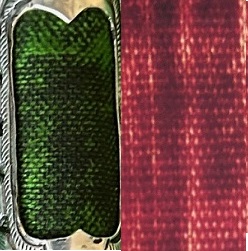
On the left is the window cut into the hilt of my sword, showing the cloth underneath. On the right is a portion of an image, taken from the back cover of Alexander's book on Islamic Arms and Armor in the Met. It is part of the scabbard of a Mughal dagger, which the book dates to 1605-1627.
I am far from suggesting my hilt dates back to the early 17th century. However, the cloth and wear pattern is consistent with something originating in the past, and within the culture the sword was meant to be used, perhaps as early as the 19th century.
Furthermore, if someone wanted to create an object with the intent to deceive, using a nice silver scroll holder which was then worked well into a hilt may not be the most cost effective approach. Besides, mounting the blade with a basket hilt, whether Scottish, a Schiavona or a Walloon would result in an item that would command a much higher price than a kaskara.
Of course, someone could have done this not for monetary gain, but simply because he wanted a cool looking sword. However, such a motive should not be restricted to modern collectors, and Pat's suggestion about an Ethiopian or Somalian origin makes a lot of sense. Just some random thoughts on a day off.